- Apr 22
Not All Problems Are the Same: Four Types Every Airline Leader Should Know
- David Lapesa Barrera
In aviation, problems happen every day. Flights are delayed, maintenance takes longer than planned, customer complaints pop up, and operational hiccups seem unavoidable. But here’s the truth: not all problems are the same, and treating every issue the same way is a trap.
Problem-solving works best when we first define the problem clearly using tools like 5W2H, which covers the what, why, where, when, who, how, and how much/how many. A precise definition ensures efforts target the real problem.
Most challenges fall into four main types, each requiring a different mindset, approach, and set of tools: Troubleshooting, Gap from Standard, New Target Condition, and Open-Ended Innovation. Let’s break them down—and see how proper problem definition powers effective solutions.
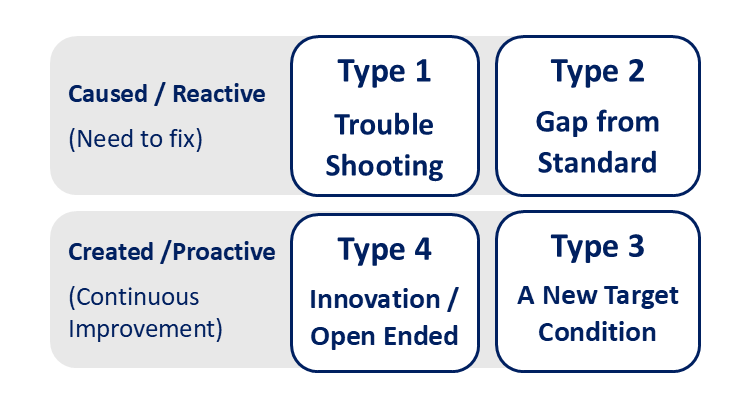
1. Troubleshooting: Fix It Fast
Some problems demand immediate action. Think of a technical fault on an aircraft, a misrouted baggage cart, or a missing part on the ramp. These are issues that need a quick solution to get operations back to normal.
Troubleshooting is reactive. The goal is simple: restore normal operations, document what happened, and move on. Overanalyzing isn’t necessary unless there’s a safety risk or you notice a repeating pattern.
Examples:
A hydraulic warning light on a narrow-body aircraft before departure. The crew and maintenance team respond, fix the issue, and document it before the next flight.
A passenger mistakenly boarding the wrong aircraft. Gate staff quickly correct it, ensuring minimal disruption.
Fueling equipment malfunctioning during turnaround. The team switches to backup systems to maintain the schedule.
The key here is speed and precision. Standard operating procedures, business process maps, checklists, and quick fixes are your tools. Record every action—today’s quick fix may reveal tomorrow’s bigger trend.
2. Gap from Standard: Understand the Deviation
Some problems aren’t urgent but have a measurable impact. For example, repeated delays, frequent rework in maintenance, or recurring customer complaints. These are gaps between actual performance and expected standards.
Solving these requires a structured, root-cause-focused approach. Root-cause analysis isn’t just about efficiency—it ensures that deviations don’t compromise safety, reliability, or regulatory compliance. Start by defining the problem clearly: what’s happening, how often, and what’s the impact? Then analyze why it’s happening, implement countermeasures, check results, and standardize improvements.
Examples:
An airline notices that 15% of short-haul departures are delayed due to late line maintenance inspections. The solution involves analyzing resource allocation, tooling availability, and workflow improvements.
Repeated customer complaints about lost luggage on a specific route. Investigation reveals gaps in baggage tracking processes, leading to better scanning and handling protocols.
Maintenance rework on maintenance inspections causing recurring operational delays. Root-cause analysis identifies unclear procedures and inconsistent training, which are corrected through standardization and follow-ups.
The key here is structured investigation. 5 Whys, Fishbone Diagrams, and interviews are your tools. Focus on uncovering root causes, implementing countermeasures, and standardizing improvements to prevent recurrence.
3. New Target Condition: Raise the Bar
Sometimes, everything is running smoothly—but “good enough” is no longer enough. Maybe competitors have improved, or your team has plateaued. These are opportunities to set a new target condition.
Here, the focus isn’t on fixing something broken but on continuous improvement. How can processes be faster, safer, or more efficient? This often involves small experiments, process redesign, or adopting new tools.
Examples:
Turnaround times have been stable at 45 minutes for regional flights. The airline sets a new target of 40 minutes and redesigns boarding, catering, and cleaning procedures to reach it.
A loyalty program meets current satisfaction benchmarks, but competitors launch a better digital experience. The airline sets a new target for digital engagement, redesigning mobile check-in and real-time notifications.
Ground handling efficiency is good, but introducing automated baggage tracking and predictive ramp scheduling can raise operational standards.
The key here is experimentation and iteration. Kaizen workshops, process mapping, and small-scale trials are your tools. Test changes, measure results, and gradually raise standards to drive continuous improvement.
4. Open-Ended Innovation: Solve the Unknown
The most exciting problems are the ones with no known solution. Open-ended problems involve radical improvement or entirely new ways to add value for passengers or operations.
This is where innovation lives. Because outcomes are uncertain, these problems require creativity, experimentation, and collaboration across teams.
Examples:
Developing predictive maintenance programs using AI and IoT sensors to prevent unscheduled downtime.
Designing entirely new operational systems, like automated ground service scheduling, that reduce human errors and improve turnaround times.
Creating unique customer experiences, such as personalized inflight services or flexible booking ecosystems, that differentiate the airline in a competitive market.
The key here is creativity and exploration. Design thinking, prototyping, pilot programs, and cross-functional collaboration are your tools. Experiment boldly, learn fast, and iterate until innovative solutions emerge.
Why This Matters
Not all problems require the same tools or effort. Some need a fast fix. Others need deep investigation. Some are about improving what’s already working, and some are about creating something entirely new.
Knowing which type of problem you face helps you decide:
When to act immediately
When to dig into root causes
When to experiment and raise performance
When to innovate boldly
In aviation, this approach turns problem-solving from a reactive task into a strategic advantage. It ensures the right effort goes to the right problem and keeps your operations safe, efficient, and competitive.
Effective problem-solving is about clarity, focus, and knowing which problem you’re really solving.
Learn to define problems with precision and master RCA tools to solve them at the root →
Author
David Lapesa Barrera is the founder of The Lean Airline® and author of The Lean Airline: Flight Excellence and Aircraft Maintenance Programs. His work focuses on lean management, operational excellence, and continuing airworthiness.