- Jan 21
SIPOC: The Starting Point for Process Improvement
- David Lapesa Barrera
Airlines constantly seek ways to streamline complex processes, eliminate waste, and create value for both the organization and its customers. One of the most effective tools to start achieving these goals is SIPOC—a visual framework that helps understand, document, and communicate the critical elements of any process.
Who provides the inputs to the process? What materials, information, or resources are supplied to the process? What are the main steps or activities involved? What are the products or services delivered by the process? Who are the end-users or recipients of the outputs?
SIPOC stands for Suppliers, Inputs, Processes, Outputs, and Customers. It provides a high-level overview of a process, showing the relationships between each component and helping teams align on objectives and responsibilities.
For airlines, SIPOC is particularly useful in complex operations such as aircraft turnaround, ground handling, maintenance, and flight planning, where multiple teams and external partners are involved. It helps stakeholders agree on process boundaries, understand the relationships between different elements, and identify potential areas for improvement.
Breaking Down SIPOC
Let's use the aircraft turnaround process as an example to show how SIPOC clarifies responsibilities, visualizes workflows, and supports lean improvement initiatives.
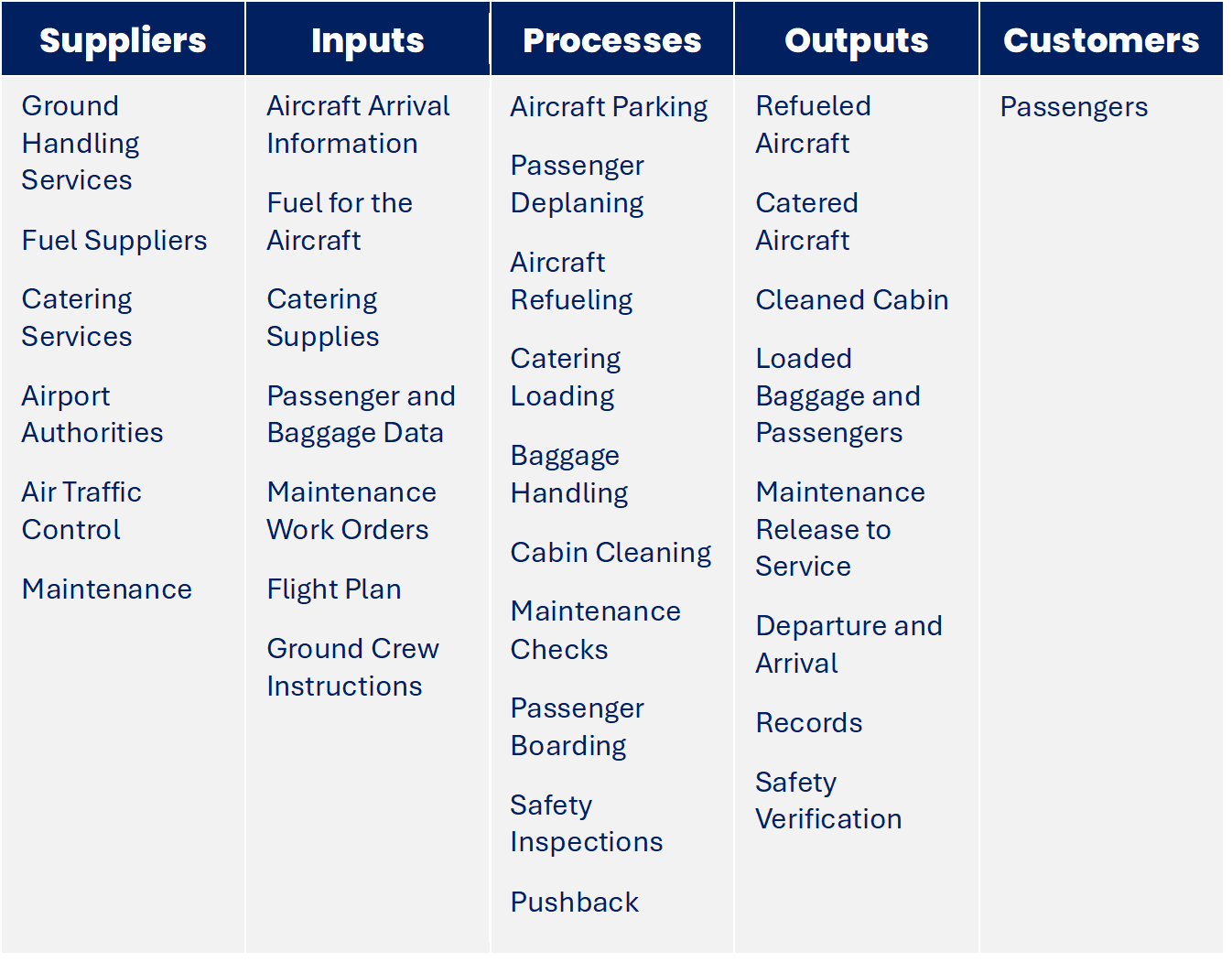
Suppliers: Suppliers provide the resources needed for a process. In aircraft turnaround, these can be external suppliers, such as fuel providers, catering services, airport authorities, and air traffic control. They can also be internal suppliers, such as maintenance teams or ground operations units that provide essential information, tools, or services to other departments. Identifying all suppliers ensures that inputs are available when needed and potential bottlenecks are addressed.
Inputs: Inputs are the materials, information, or resources required to execute the process. For an aircraft turnaround, inputs may include fuel, catering supplies, maintenance work orders, passenger and baggage data, flight plans, and ground crew instructions. Inputs can come from both internal teams and external partners, and each must meet quality and timing standards to ensure smooth operations.
Processes: Processes are the steps or activities that transform inputs into outputs. SIPOC focuses on high-level steps rather than detailed task lists. In aircraft turnaround, processes include parking and arrival, passenger deplaning, aircraft refueling, catering loading, baggage handling, cabin cleaning, maintenance checks, passenger boarding, safety inspections, and pushback operations. Visualizing these steps helps teams understand sequences, interactions, and dependencies.
Outputs: Outputs are the products or services resulting from the process. In this example, outputs include a refueled aircraft, a catered and cleaned cabin, loaded baggage and passengers, completed maintenance tasks, and verified safety records. Outputs are the tangible results that demonstrate whether the process delivers value.
Customers: Customers are the recipients of outputs, whether internal or external. Internal customers in airline operations might include flight crews or operations teams that rely on timely and accurate work. External customers can include passengers or regulatory authorities. Identifying customers ensures that processes meet their needs and expectations, improving service quality and operational performance.
Using SIPOC, an airline can visualize the connections between ground handling services, fuel suppliers, catering providers, maintenance teams, and the flight crew. It highlights how inputs such as fuel and passenger data are transformed through a series of coordinated activities into outputs that deliver value to both passengers and operational teams.
A SIPOC diagram also helps define process boundaries. This clarity is essential when multiple departments and external suppliers are involved. Teams can quickly identify where delays may occur, which activities add value, and where improvements can be made.
Focusing on Value and Eliminating Waste with SIPOC
At the core of lean thinking is value. Every process step should contribute to something the customer values. In airline operations, this could be safe and timely departures, accurate maintenance, efficient baggage handling, or smooth coordination between teams. Steps that do not add value are considered waste.
SIPOC helps teams focus on value by linking inputs, processes, and outputs to the customer. This makes it easier to see which activities are essential and which create delays, rework, or inefficiencies. Wastes can be categorized using TIMWOODS: Transportation, Inventory, Motion, Waiting, Overproduction, Overprocessing, Defects, and Skills underutilization. For example, baggage moved multiple times (Transportation), an idle aircraft waiting for catering (Waiting), or repeated data checks (Overprocessing/Defects) all slow operations.
In aircraft turnaround, a clear understanding of value can lead to simpler boarding, better ground coordination, or improved communication between teams. SIPOC doesn’t solve these issues directly, but it makes them visible and easier to address. Linking SIPOC to TIMWOODS helps teams systematically remove non-value activities, ensuring every step contributes to efficiency and passenger satisfaction.
For this reason, SIPOC is often the starting point for process improvement, defining scope and responsibilities before moving to Value Stream Mapping (VSM) to analyze end-to-end flow and Business Process Mapping (BPM) to detail steps, roles, and decision points for further optimization.
Benefits of SIPOC
Clarity and Alignment: Visualizing all process elements ensures teams understand their responsibilities and dependencies.
Focus on Value: Identifying what truly matters allows teams to remove waste and streamline operations.
Process Simplification: SIPOC highlights unnecessary steps and areas where resources can be better allocated.
Stakeholder Engagement: A visual overview makes it easier to communicate across departments and with external suppliers.
Foundation for Improvement: SIPOC establishes a clear baseline and scope, providing the first step toward detailed process analysis.
By mapping suppliers, inputs, processes, outputs, and customers—and maintaining a clear focus on what adds value while eliminating what does not—SIPOC serves as a strategic tool for process improvement. Whether applied to aircraft turnaround, maintenance, or other critical airline processes, SIPOC provides a structured starting point for building leaner, more effective operations.
Learn to map, analyze, and improve processes using SIPOC and other practical tools →
Author
David Lapesa Barrera is the founder of The Lean Airline® and author of The Lean Airline: Flight Excellence and Aircraft Maintenance Programs. His work focuses on lean management, operational excellence, and continuing airworthiness.