- Nov 13, 2024
Value Stream Mapping: Seeing the Full Picture
- David Lapesa Barrera
In a previous article, we discussed Business Process Mapping, a useful method for understanding and improving individual processes. Here, we expand that perspective by examining Value Stream Mapping, the comprehensive end-to-end approach that helps us understand how an organization delivers value.
What is Value Stream Mapping (VSM)?
A value stream encompasses every action - both value-adding and non-value-adding - required to bring a product or service to your customer. Whenever there is a product or service for a customer, there is at least a value stream. Think of it as a roadmap that helps you visualize how work flows from start to finish, ensuring you capture the big picture rather than just focusing on isolated departments, functions, or processes.
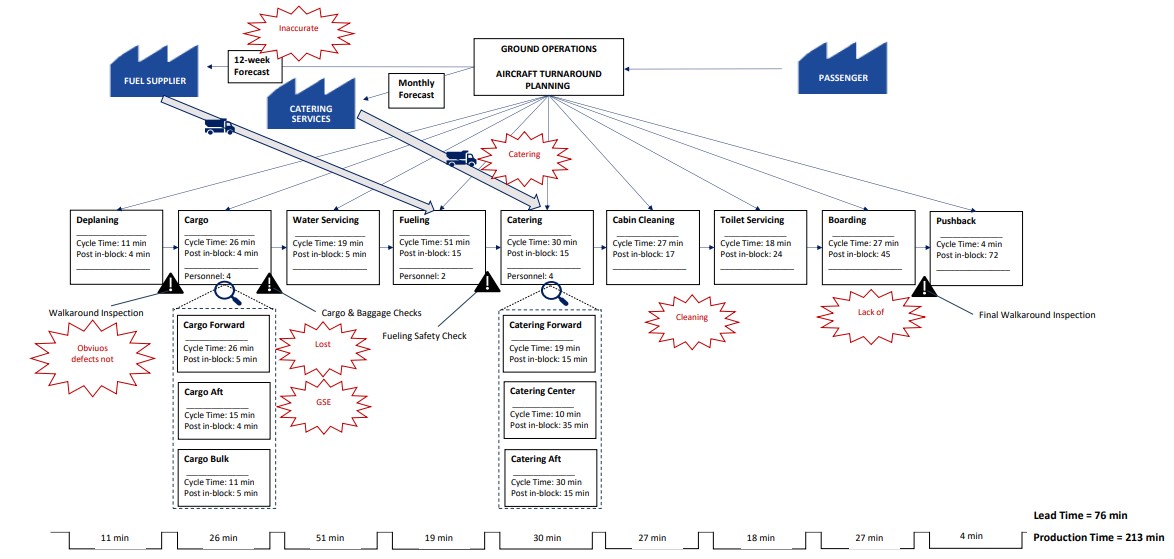
Example: Aircraft Turnaround Value Stream
To illustrate Value Stream Mapping in aviation, consider the aircraft turnaround process at an airport. This value stream may include activities such as aircraft arrival, passenger disembarkation, cleaning, catering, refueling, baggage handling, and boarding.
By mapping the entire turnaround value stream, organizations can visualize how these activities interact and identify delays, bottlenecks, or coordination issues between teams. For example, delays in baggage unloading may affect cleaning operations or boarding readiness.
A Value Stream Map helps teams identify these inefficiencies and redesign the flow of activities to improve turnaround time and operational reliability.
Why is Value Stream Mapping Important?
Understanding the value stream allows organizations to move beyond isolated improvements and focus on how the entire system performs. Value Stream Mapping provides several important benefits.
Holistic View: VSM helps to see and understand the flow of goods, materials, and information (value).
Identify Waste: By mapping out the current state, you can pinpoint inefficiencies - such as bottlenecks, delays, and redundancies - draining your resources and stalling progress.
Enhance Collaboration: Engaging cross-functional teams in the mapping process fosters a culture of continuous improvement, where every team member can contribute valuable insights.
Focus on Customer Value: The ultimate goal of VSM is to streamline processes to maximize value for your customers. By eliminating waste, you enhance the customer experience, driving satisfaction and loyalty.
Steps to Effective Value Stream Mapping
Once the value stream is understood conceptually, the next step is to map and improve it. The following framework provides a practical approach to conducting a Value Stream Mapping exercise.
Draw the Current State Map: Assemble a cross-functional team to document existing processes, establishing a baseline for improvement.
Identify Waste and Root Causes: Analyze your current map to pinpoint inefficiencies. What steps add no value? Where are the bottlenecks?
Design the Ideal State: Dream big and envision the perfect flow, free of waste. Brainstorm how to achieve this ideal state.
Create a Realistic Future State: Translate your ideal vision into actionable steps. Redraw the map reflecting your optimized processes.
Implement the Future State: Mobilize your team to execute the new processes and monitor results for continuous improvement.
Embrace the Tools Available
Value Stream Mapping can be performed using simple tools such as whiteboards and sticky notes. However, digital tools can also help teams collaborate more effectively and capture process data that supports deeper analysis.
Regardless of the tool used, the key objective remains the same: clearly understanding how value flows through the organization.
Conclusion
Value Stream Mapping provides organizations with a structured way to understand how value flows across activities, departments, and processes. By visualizing the end-to-end value stream, teams can identify inefficiencies, improve coordination, and implement meaningful operational improvements.
Learn more about process mapping and analysis techniques →
Author
David Lapesa Barrera is the founder of The Lean Airline® and author of The Lean Airline: Flight Excellence and Aircraft Maintenance Programs. His work focuses on lean management, operational excellence, and continuing airworthiness.