- Aug 19
Strategy Under Pressure: A SWOT View of Airlines
- David Lapesa Barrera
In airline management, decisions are rarely driven by a single perspective. Operational performance, market dynamics, regulatory environments, and customer expectations interact simultaneously in a highly complex and pressure-driven system.
Airlines are currently operating under sustained cost inflation, capacity constraints in parts of the global supply chain, evolving sustainability requirements, and rapidly changing passenger expectations. For this reason, structured analysis tools are convenient to support strategic decision-making.
These dynamics are influenced by the airline’s business model and how value is created and delivered internally through its operational structure.
A widely used strategic framework for this purpose is SWOT analysis, which evaluates an organization through four dimensions: Strengths, Weaknesses, Opportunities, and Threats. It provides a structured way to interpret both internal capability and external pressures.
Although simple in structure, SWOT reflects the operational reality of airlines, where performance is determined by the interaction between internal capabilities and external conditions.
SWOT as a Structured Strategic Lens
SWOT analysis helps organizations translate operational and market observations into strategic awareness. It does not replace detailed process analysis or financial evaluation, but it provides a clear synthesis of the internal and external factors influencing performance in a highly dynamic industry such as aviation.
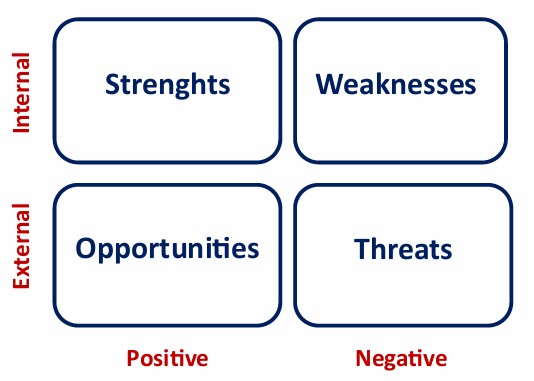
Strengths: Internal Drivers of Competitive Advantage
Strengths refer to internal capabilities that enable an airline to perform effectively in the market. These are grounded in operational reality and can often be observed directly in day-to-day performance.
In the airline context, strengths may include strong safety performance, reliable operational execution, efficient turnaround processes, skilled workforce, or the effective use of digital tools in operations and customer service. These elements directly influence punctuality, cost efficiency, and customer satisfaction.
From a Lean perspective, strengths are most relevant when they contribute to value creation while minimizing waste and variability, both of which are critical in a high-complexity operational environment.
Weaknesses: Internal Gaps and Constraints
Weaknesses represent internal limitations that reduce efficiency, increase cost, or negatively affect customer experience. These can appear across all areas of the organization, from operational execution to coordination between departments.
In many airlines, common weaknesses include fragmented processes, legacy systems, inconsistent service delivery, or limited cross-functional alignment. In an environment defined by tight margins and high variability, these weaknesses often have a direct impact on performance reliability and cost control.
Identifying weaknesses is not about assigning responsibility, but about understanding where operational flow is disrupted and where improvement can generate the greatest impact, often visible through the airline’s value chain analysis.
Opportunities: External Drivers of Change
Opportunities arise from external conditions that can be leveraged to improve performance or strengthen competitive positioning. The airline industry is particularly exposed to external change, including evolving passenger expectations, technological innovation, environmental requirements, and shifts in global demand.
Current industry developments such as digital transformation, sustainability pressures, and changing workforce dynamics are reshaping how airlines operate and compete. However, opportunities only become meaningful when they align with internal capability and execution readiness.
Threats: External Pressures and Industry Volatility
Threats represent external factors that can negatively affect performance. Unlike internal weaknesses, these are not directly controllable, but they must be continuously monitored and managed.
For airlines, threats often include fuel price volatility, geopolitical instability, regulatory changes, capacity imbalances, and competitive pressure. In addition, the industry remains highly sensitive to disruptions, whether operational, environmental, or macroeconomic.
A structured SWOT approach ensures these risks are not treated in isolation, but as part of a broader understanding of operational resilience and strategic exposure.
Conclusion
SWOT analysis remains a practical and widely used tool for understanding an airline’s strategic position. Its value lies in its simplicity and ability to structure complex realities into a clear framework for reflection and decision-making.
In a highly competitive and volatile industry, this structured view supports better alignment between operational capability and external demands. It helps airline leaders understand not only what is happening, but why it is happening, and where focused improvement or strategic action is required.
Learn more about airline management and strategy →
Author
David Lapesa Barrera is the founder of The Lean Airline® and author of The Lean Airline: Flight Excellence and Aircraft Maintenance Programs. His work focuses on lean management, operational excellence, and continuing airworthiness.