- Oct 1, 2025
The Airline Value Chain: Understanding How Airlines Create Value
- David Lapesa Barrera
Airlines are complex organizations where hundreds of activities—from aircraft maintenance and flight operations to sales, customer service, and IT—must work together to deliver safe, reliable, and profitable air transport. Understanding how these activities interact is essential for improving efficiency, controlling costs, generating revenue, and delivering value to passengers.
One of the most useful frameworks for analyzing how organizations create value is the value chain, a concept introduced by Michael Porter, a Harvard Business School professor. The value chain views an organization as a system of interconnected activities that transform inputs into products or services that customers are willing to pay for.
“The idea of the value chain is based on the process view of organizations, the idea of seeing a manufacturing (or service) organization as a system, made up of subsystems, each with inputs, transformation processes, and outputs. Inputs, transformation processes, and outputs involve the acquisition and consumption of resources – money, labor, materials, equipment, buildings, land, administration, and management. How value chain activities are carried out determines costs and affects profits.” – Michael Porter
In other words, every activity in an airline—from flight operations to human resources—contributes to the value delivered to passengers and the airline’s profitability.
Components of a Value Chain
To understand the value chain of an organization, it is necessary to classify all activities that contribute to its margin. Margin represents the profitability of the company and is defined as the difference between the total value received from customers (revenue) and the total cost incurred to create and deliver the product or service.
1. Core (Primary) Processes
Core processes are those that directly add value to the customer. In airlines, these core processes include the main operational activities required to deliver air transport services. In Porter’s model, five primary activities are required to create, sell, maintain, and support a product or service:
Inbound Logistics: activities involved in receiving, storing, and distributing inputs.
Operations: activities that transform inputs into final products or services. In airlines, this includes flight operations, maintenance, and ground handling.
Outbound Logistics: activities related to delivering the service or product to customers, such as baggage handling or cargo distribution.
Marketing and Sales: activities required to promote and sell services.
Service: activities that provide after-sales support, including customer service and loyalty programs.
2. Support (Secondary) Processes
Support processes do not directly deliver value to the final customer but are essential in enabling the primary processes to function effectively. These include:
Infrastructure: management, finance, and legal systems that support decision-making.
Human Resource Management: hiring, training, and retaining skilled employees.
Technology Development: research, innovation, and IT systems that enable transformation of inputs into outputs.
Procurement: purchasing inputs required for both core and support activities.
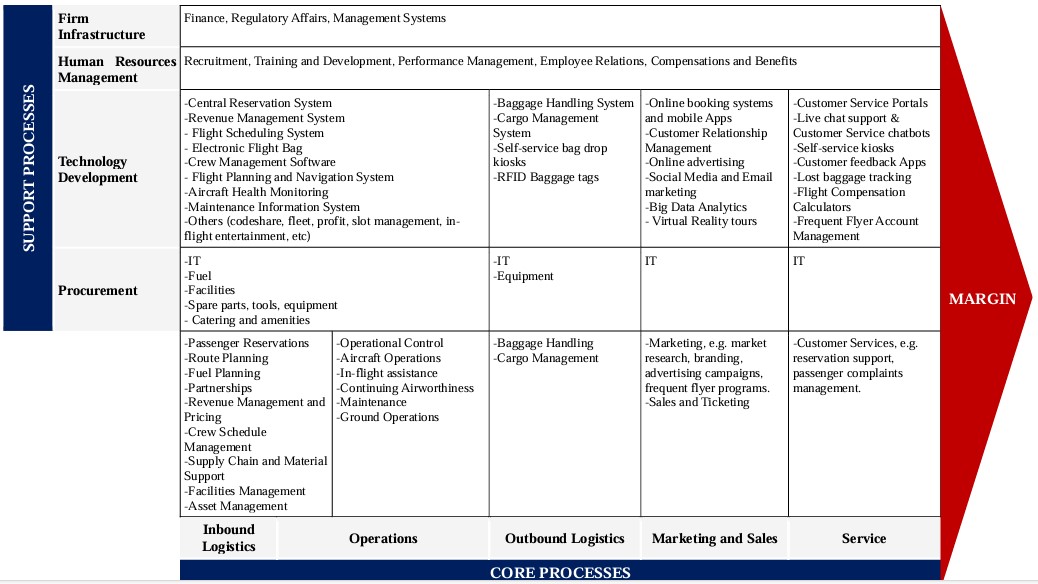
Mapping the value chain allows airline leaders to see the big picture of how all activities—customer-facing or internal—contribute to profitability and value creation. This understanding is the foundation for identifying opportunities to improve efficiency, reduce costs, and enhance the customer experience.
Value Chain vs. Value Stream
It’s important to distinguish between value chain and value stream because they serve different purposes and provide different insights:
Value Chain: A strategic, high-level view of all activities that create value across the entire organization—from supplier inputs to customer delivery. It shows what activities exist and how they contribute to overall profitability.
Value Stream: A lean-focused tool that maps the specific flow of materials, information, or services for a particular product or process. It highlights where waste occurs and where efficiency can be improved.
In simple terms, the value chain shows the big picture of value creation, while the value stream zooms in on the operational flow to identify improvement opportunities. Both are complementary: understanding the value chain helps leaders prioritize which value streams to optimize for maximum impact.
Conclusion
Understanding the value chain helps airline leaders see how different activities contribute to creating value and generating profitability across the organization.
In practice, these activities can be grouped into airline core processes, which directly deliver value to customers, and support processes, which enable the organization to operate effectively.
Looking at both perspectives helps organizations better understand how value is created and where improvements can have the greatest impact.
Learn more about airline management →
Author
David Lapesa Barrera is the founder of The Lean Airline® and author of The Lean Airline: Flight Excellence and Aircraft Maintenance Programs. His work focuses on lean management, operational excellence, and continuing airworthiness.