- Jun 18, 2025
The 80/20 Rule: Focus on What Matters and Achieve More
- David Lapesa Barrera
When cleaning your home, you might notice that areas like the kitchen or living room get messier than others. By focusing on these first, you'll quickly make most of your home feel tidy before tackling the smaller areas.
In airlines, the challenge is no so different. With both safety and customer value as foundational priorities, limited time and resources often make it difficult to decide where to focus first. There's no shortage of data—incident reports, audit findings, customer feedback, and process metrics—but the key is turning that data into action.
The Pareto Principle, or 80/20 rule, suggests that a small number of causes are usually responsible for the majority of outcomes. In other words, 80% of the problems can be solved by eliminating 20% of their causes. Pareto Analysis is a practical tool that helps teams identify which few issues are driving most of the problems—and where intervention can deliver the biggest impact.
As we've discussed in other articles, a Lean Airline focuses on three interrelated core dimensions: safety, financial, and lean performance. Let's explore how Pareto Analysis can drive improvements in each of these areas.
Safety: From Volume to Focus
Safety management involves analyzing hundreds, sometimes thousands, of reports each year. These range from low-risk observations to high-consequence occurrences. Without structure, efforts to act on them can become scattered or reactive.
Using Pareto Analysis, airlines can group incidents by type or root cause. For example, an airline may discover that three categories—miscommunication during ground operations, fatigue-related errors, and inconsistent checklist usage—account for over 70% of reported occurrences in a given period. With that insight, the response becomes focused: review procedures, enhance briefings, and improve crew rostering practices.
This doesn’t mean the remaining 30% of issues are ignored. But in a resource-limited environment, it’s more effective to concentrate improvement efforts where they will reduce the highest risk exposure. Fewer scattershot actions. More targeted impact.
Pareto Analysis becomes a filter—not to simplify safety, but to bring clarity and focus to how it's managed.
Financial Performance: Finding the Hidden Cost Drivers
Every airline decision carries a cost, and with tight margins, financial performance can't be separated from operational strategy. Yet financial inefficiencies are not always easy to spot—they’re often buried in recurring issues like aircraft downtime, reactive maintenance, overstocked inventory, or unnecessary fuel burn due to suboptimal procedures.
Pareto Analysis helps bring visibility to these hidden cost drivers. For example, an airline analyzing unplanned maintenance costs might find that 20% of component types are responsible for 80% of total spend. This insight allows procurement, engineering, and maintenance teams to prioritize supplier reviews, reliability programs, or repair contracts where they will have the highest return on investment.
Similarly, delays might seem like an operational issue, but when analyzed through a financial lens, a few specific root causes—such as late catering, gate conflicts, or turnaround inefficiencies—can translate into the majority of the airline’s delay compensation and missed connection costs.
By using Pareto to connect operational patterns with financial impact, airlines can shift to proactive investment—targeting the few systemic issues that quietly erode profitability. It’s not about trimming across the board; it’s about improving where it matters most.
Aligning with What Passengers Truly Value
From a customer perspective, value in air travel is tied to more than just ticket price or entertainment screens. It's about reliability, clear communication, comfort, and trust in the airline's safety culture, and it depends on the airline value proposition.
Customer feedback systems can reveal a long list of complaints or suggestions. Without prioritization, well-intentioned teams might invest time solving less critical issues—like minor meal dissatisfaction—while overlooking more significant pain points such as unclear rebooking processes or inconsistent handling during disruptions.
Pareto Analysis helps bring structure to customer feedback by highlighting the few service gaps that cause the most dissatisfaction or mistrust. This could include slow response times during irregular operations, inconsistent boarding processes, or cabin cleanliness.
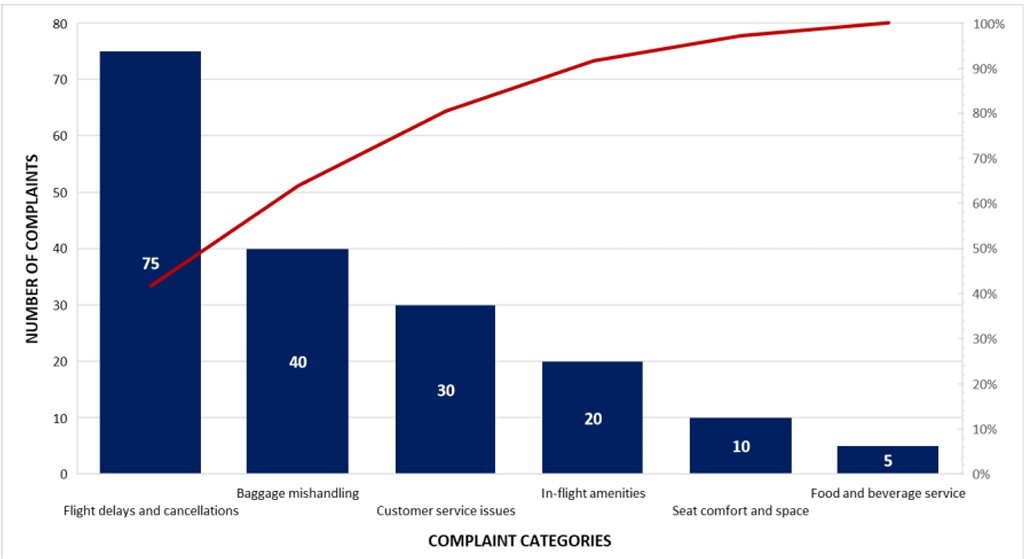
Illustrative Pareto chart example showing how a few complaint categories account for the majority of passenger dissatisfaction.
By addressing the top contributors to negative customer experience, airlines demonstrate commitment to what matters most to passengers. This isn’t just good service—it’s good strategy. And in a competitive market, attention to customer-defined value builds loyalty and strengthens reputation.
A Note on Complexity and Interdependence
While Pareto Analysis assumes independence among causes, real-life aviation systems are interconnected. A safety issue may have roots in both training gaps and staffing levels. A customer experience issue might stem from both technology limitations and poor internal coordination.
The analysis doesn't ignore this complexity, but it doesn’t capture it on its own. That’s why it's best used as a starting point, often followed by deeper techniques such as Root Cause Analysis or Business Process Mapping.
The strength of Pareto Analysis lies in its simplicity. It breaks through noise and focuses attention. But the analysis should always be followed by thoughtful, systemic thinking—especially in safety and service environments where consequences are high.
Conclusion
Aviation is full of moving parts, and not all problems are equal. Whether working to prevent safety occurrences or improve what customers truly value, the challenge is knowing where to focus first.
By applying Pareto Analysis, teams avoid the trap of trying to “fix everything.” Instead, they make informed choices about what to fix first—especially important in a resource-limited environment. Although Pareto Analysis doesn’t offer all the answers, it does ask the right question: Which few causes are causing most of the problems?
Once that’s clear, decisions become sharper, resources go further, and improvements reach the areas where they matter most.
So, when everything feels important, focus on what matters most with Pareto!
Author
David Lapesa Barrera is the founder of The Lean Airline® and author of The Lean Airline: Flight Excellence and Aircraft Maintenance Programs. His work focuses on lean management, operational excellence, and continuing airworthiness.