- Sep 17, 2025
From Compliance to Continuous Improvement: Standardized Work
- David Lapesa Barrera
In aviation, tight schedules, safety-critical procedures, and fluctuating demand leave no room for errors. Variability is the enemy.
Standardized Work is one of the most effective ways to reduce that variability, increase consistency, and ensure compliance. By documenting clear, reliable best practices, it gives every team member a shared reference, keeping operations safe, efficient, and predictable.
Processes can be captured in many formats—manuals, standard operating procedures, checklists, work instructions, or business process maps—but even the most detailed resources leave room for individual interpretation. Without a consistent foundation, meaningful improvement becomes difficult, because you can’t refine a process that isn’t fully understood.
Standardized Work Defined
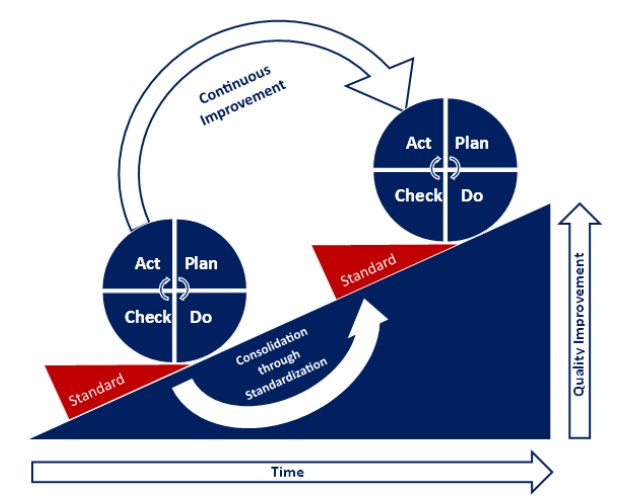
Standardized work is about documenting and implementing the most effective way to perform tasks while strictly adhering to regulations, manufacturer manuals, and internal safety standards. It sets a clear baseline for operations, ensuring every employee knows exactly how a task should be performed. In other words, it provides a foundation from which teams can identify improvements and implement changes in a controlled, compliant way.
Rules First: Compliance
The principle of “rules in first instance” is central to aviation. No matter how efficient a workflow becomes, it must always align with:
Regulatory Requirements – Procedures must comply with EASA, FAA, or other national aviation authority regulations.
Manufacturer Instructions – Aircraft and equipment must be serviced and operated according to the manufacturer’s manuals and instructions.
Internal Safety Standards – Airlines and maintenance organizations often set additional standards to ensure consistent quality and operational safety.
In practice, this means that standardized work cannot bypass, alter, or ignore mandatory regulations. Improvements focus on workflow efficiency, organization, and waste reduction, within the boundaries of safety and compliance.
The Gemba Approach: Observing Real Work
Creating effective standardized work starts at the Gemba, the place where value is created, whether it’s the hangar, cockpit, or gate. Observing frontline employees performing their daily tasks is key to understanding how work actually happens.
Those who execute the work daily have invaluable insights into bottlenecks, inefficiencies, and practical solutions. Involving them in documenting procedures ensures that standards are realistic, safe, and actionable. Additionally, employee involvement promotes ownership, increasing compliance with standardized procedures.
Key Components of Standardized Work in Aviation
A well-structured standardized work procedure in aviation typically includes:
Sequence of Steps – Exact order of operations, including mandatory safety checks, inspection points, and regulatory compliance steps.
Visual diagrams of workflows – Business Process Mapping help teams see the full process, understand dependencies, and spot areas for improvement.
Takt Time and Timing Guidelines – Pace of work aligned with operational needs and safety requirements, ensuring tasks are neither rushed nor delayed.
Work-in-Process and Resource Management – Clear instructions on materials, tools, and equipment to avoid errors and bottlenecks.
Visual Aids and Checklists – Diagrams, color-coded labels, and checklists simplify complex procedures and reduce human error.
Key Performance Indicators (KPIs) and Monitoring – Metrics to track adherence, efficiency, and safety outcomes.
Benefits Beyond Compliance
Once standardized work is properly implemented, the benefits extend beyond mere compliance.
Safer Operations – By documenting the required steps and regulatory requirements, teams have a reference to follow, which reduces the likelihood of errors.
More Predictable Outcomes – Clear procedures help reduce variability across teams and shifts, making results more consistent.
Structured Training – Having documented procedures makes it easier to onboard new personnel and communicate expectations, though effective training still requires guidance and oversight.
Platform for Improvement – Standards give teams a starting point for identifying inefficiencies and testing improvements in a controlled, compliant way.
Common Misconceptions
Some assume that standardized work restricts innovation. In aviation, it actually enables creativity by freeing mental space from repetitive decisions and allowing teams to focus on problem-solving within safe boundaries. Another misconception is that standards are fixed; in reality, they are living documents, regularly reviewed to incorporate best practices, new technologies, and operational insights.
Implementing Standardized Work Successfully in Aviation
Observe and Understand – Document how tasks are currently performed while ensuring safety steps and compliance with regulations are respected. You can create a process map to understand how tasks flow, where handoffs occur, and which steps are critical for compliance and safety.
Define Best Practices – Identify the most efficient, compliant, and safe method.
Document Clearly – Use checklists, manuals, and visual aids. Ensure instructions are easily understood by all team members.
Train and Reinforce – Provide training and refreshers to maintain adherence.
Review and Improve – Continuously update standards to reflect operational improvements, technology upgrades, or regulatory changes.
Take Your Skills Further
Standardized Work is the backbone of operational excellence. When combined with Business Process Mapping to clearly document processes and PDCA to guide continuous improvement, it helps teams work more efficiently, reduce errors, and continuously improve their operations.
Author
David Lapesa Barrera is the founder of The Lean Airline® and author of The Lean Airline: Flight Excellence and Aircraft Maintenance Programs. His work focuses on lean management, operational excellence, and continuing airworthiness.