- Feb 26, 2025
Kata: Continuous Improvement Inspired by Martial Arts
- David Lapesa Barrera
What separates top-performing organizations from the rest? A relentless commitment to continuous improvement.
Cultivating this culture is crucial for achieving lasting results. It’s about fostering an environment where innovation, problem-solving, and growth become part of the daily routine. One powerful method to support this is Kata, a concept inspired by martial arts. Kata helps organizations build the habits needed to drive sustained improvement and develop a mindset that thrives on challenge and progress.
So, what exactly is Kata?
The term Kata originates from martial arts and refers to a set pattern or form of movements that are practiced repetitively to improve technique and precision. In the world of Lean methodologies, Kata is used to guide individuals and teams through a structured and iterative process of continuous improvement.
At Toyota, Kata evolved into a methodology to help develop a mindset that drives both personal and organizational growth. The Toyota approach has two core dimensions.
Improvement Kata is a routine designed to guide individuals or teams through the process of making improvements in a structured and scientific manner. It involves setting challenging yet achievable improvement goals, understanding the current condition (the present state or situation of a process or system) and challenges, experimenting with potential solutions, and learning from the results.
Coaching Kata is a routine for leaders or coaches to guide and develop the problem-solving and improvement skills of individuals or teams. Imagine an airline operations manager working with their team to reduce turnaround times. Instead of simply giving orders, they use Coaching Kata—asking structured questions, guiding problem-solving efforts, and fostering a culture where employees take ownership of improvements. This approach not only builds problem-solving capabilities but also nurtures a learning-oriented mindset.
The Kata Process: A Cycle of Continuous Improvement
The core of Kata lies in its iterative cycle, which promotes constant refinement and learning. Here’s how it works:
Understand the Direction: This step helps define a clear and challenging goal, one that aligns with the organization’s broader objectives.
Grasp the Current Condition: Next, the current process is analyzed, data is collected, and challenges are identified.
Establish the Next Target Condition: After understanding where we are, the next step is to set specific, measurable targets to aim for.
Experiment Toward the Target Condition: In this step, small, iterative experiments are conducted. These experiments allow teams to adjust their approach based on the feedback and data collected.
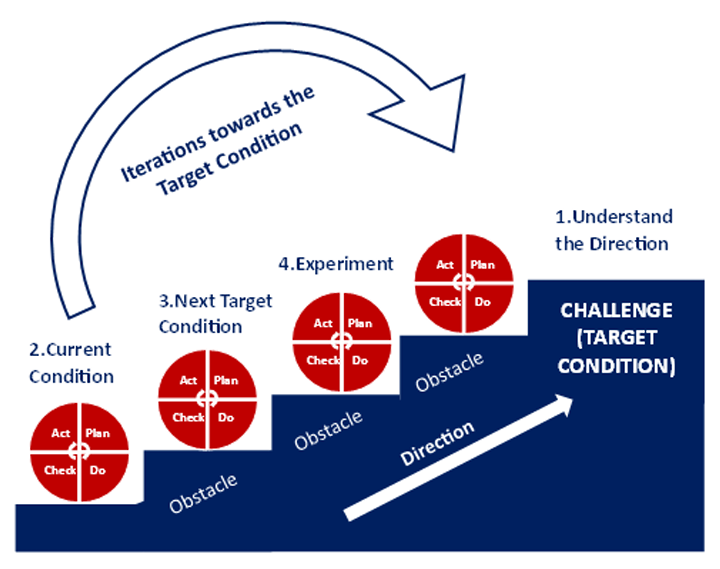
Once one cycle is complete, the lessons learned inform the next cycle, creating a loop of continuous improvement. This approach not only improves the current processes but helps to instill a mindset of innovation and growth within our teams.
By following this structured approach, teams make data-driven decisions rather than relying on assumptions.
The Role of Scientific Thinking in Kata
The power of Kata lies in its emphasis on scientific thinking, a vital skill for anyone working in a problem-solving role. Scientific thinking is all about applying the scientific method to everyday challenges—formulating hypotheses, running small experiments, analyzing data, and refining solutions based on what we’ve learned. This methodical approach ensures that decisions are based on real-world evidence, not assumptions.
For The Lean Airline, scientific thinking is crucial for decision-making. Whether we’re tweaking operational processes or experimenting with new technologies, every step is guided by evidence. By adopting this structured approach, we reduce biases and increase the likelihood of successful outcomes.
Training with Kata: Who Benefits the Most?
Kata’s principles can benefit individuals across the organization, but it’s particularly impactful for those directly involved in problem-solving, decision-making, and process improvement. It’s not always necessary for everyone in the organization to undergo formal Kata training, but for key roles that drive operational excellence, Kata is invaluable.
Integrating Kata into existing training programs and aligning it with existing performance management frameworks, we ensure that our teams are not only meeting objectives but also consistently improving their problem-solving abilities.
Kata and Safety: A Key Consideration for Aviation Organizations
Of course, when applying Kata, we must always consider safety regulations. Experimenting with solutions should never compromise safety. All improvement initiatives must align with industry safety standards and comply with regulatory requirements. Kata's scientific thinking approach helps ensure that solutions not only improve efficiency but also do so within the boundaries of safety and compliance.
Conclusion
Kata is a structured approach that empowers individuals, teams, and organizations to continuously evolve, adapt, and drive innovation. By embracing Kata, you not only stay competitive but also set the standard for operational excellence, safety, and sustained improvement.
Author
David Lapesa Barrera is the founder of The Lean Airline® and author of The Lean Airline: Flight Excellence and Aircraft Maintenance Programs. His work focuses on lean management, operational excellence, and continuing airworthiness.