- Aug 26, 2025
A Win for the Ozone Layer: The Final Chapter for Halon Portable Extinguishers in Cabins
- David Lapesa Barrera
Although Halon portable fire extinguishers have gradually been phased out for installation in new aircraft cabins and crew compartments over the past decade, existing Halon extinguishers have been allowed to continue in service. In EU regulations, however, this is only allowed until 31 December 2025. By that date, all remaining Halon portable extinguishers in aircraft cabins and crew compartments must be retired or replaced. In other words, no Halon portable fire extinguishers may remain in service after 2025.
Halons, used in aircraft fire systems, are hard to replace due to their effectiveness. Their use is limited by cut-off dates for new equipment and end dates for existing systems, after which they must be decommissioned.
The Ozone Layer
The ozone layer in the upper atmosphere protects life on Earth from harmful UV radiation. In the 1970s, scientists discovered that ozone-depleting substances (ODSs) damage this layer. To address this, the Vienna Convention (1985) and the Montreal Protocol (1987) were adopted to phase out ODS production and use. These measures have reduced ODS emissions and shown early signs of ozone recovery, but full recovery to pre-1980 levels is not expected until mid-century.
ODSs also have high global warming potential, so alternatives with lower impact are needed. The EU has implemented regulations eliminating key ODSs and is a leader in ozone protection.
Many other nations are also aligning with the Montreal Protocol and implementing their own regulations to phase out Halon use. The timelines and specifics can vary, but the global trend is towards reducing and eliminating Halon due to its environmental impact.
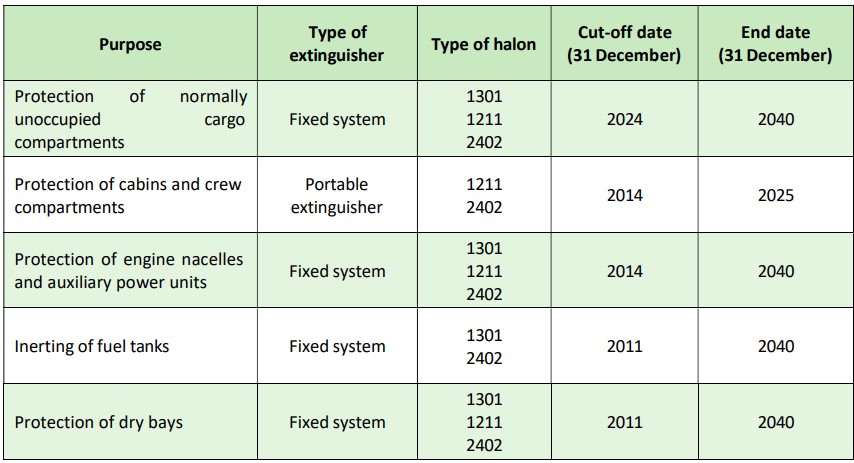
Figure- Halon uses with cut-off and end dates (Halon replacement in the aviation industry. February 2025. EASA.)
Operational Impacts
Replacing Halon portable extinguishers also has several operational considerations. The new extinguishers may differ in weight, size, and discharge characteristics, affecting the aircraft’s weight and balance as well as the emergency equipment layout.
From the design organization perspective, documents such as the Instructions for Continued Airworthiness (ICA), including the Aircraft Maintenance Manual (AMM), and Operational Suitability Data (OSD) must be updated to reflect handling and operating procedures, maintenance requirements, and new inspection intervals.
From the operator perspective, the Aircraft Maintenance Program (AMP), maintenance and operating procedures, crew training materials, and emergency response checklists may need revision to ensure proper use, accessibility, and compliance.
Challenges with Replacements
Historically, Halon 1211 has been the most common extinguishing agent in handheld fire extinguishers used in aircraft cabins and crew compartments. Today, however, Halon is no longer produced and its use is limited to recycled recovery.
The currently certified aviation-approved alternatives come with important trade-offs. They are significantly heavier and bulkier than Halon 1211, often less efficient in extinguishing fires, and in some cases can leave behind residues that pose health risks to occupants. The added weight also means more fuel consumption, indirectly increasing CO₂ emissions. To complicate matters further, several of these substitutes have been shown to carry a global warming potential even higher than Halon itself — raising fresh environmental concerns despite being introduced as replacements.
On top of these technical challenges, the financial impact can be significant. Replacement extinguishers are generally more expensive to purchase and install, and integrating them requires a certified design change. Because the fire extinguisher is part of a safety-critical system, this replacement is likely classified as a Major Change under EASA Part-21. The Type Certificate Holder must approve the change, ensuring compliance with airworthiness requirements, and update the Instructions for Continued Airworthiness (ICA) or IPC to include guidance for operators and maintenance personnel. This ensures that safety, performance, and regulatory standards continue to be met.
Update (EASA CM–CS-013 Issue 01, 29 Sep 2025):
Design changes for installing Halon-free handheld extinguishers in passenger or crew compartments may be classified as Minor Changes, provided that the guidance of this Certification Memorandum is followed, approved extinguishing agents are used, and the design change can be classified as Minor based on the guidance of GM 21.A.91. This reduces the certification burden compared to the historical assumption of a Major Change. Although the reclassification streamlines the approval process, the late publication raises questions about timing and fairness. Early adopters faced greater certification complexity and cost, effectively being penalized for their proactive compliance efforts. Nevertheless, this clarification represents a positive and pragmatic step toward reducing the certification burden compared to the historical assumption of a Major Change.
And while the deadline for Halon portable extinguishers in cabins and crew compartments is fast approaching in Europe, Halon will remain in service longer in other critical aircraft systems. It’s still used for protecting cargo compartments, engine nacelles, auxiliary power units, fuel tank inerting, and dry bays, with a regulatory phase-out date currently set for 2040.
Derogation
Derogations from cut-off and end dates can be granted by the European Commission at the request of the competent authority of a Member State where it is demonstrated that no technically and economically feasible alternative is available. EASA cannot grant these exceptions. For example, Poland has requested a derogation extending the deadline for its use in aircraft cabins and crew compartments until 31 December 2040.
Conclusion
The retirement of Halon portable extinguishers in aircraft cabins and crew compartments marks a significant step for environmental protection of the Ozone Layer. Although Halon will continue in other critical aircraft systems until 2040, this phase-out demonstrates the industry’s commitment to sustainable practices.
Learn how to manage aircraft design and configuration changes →
Author
David Lapesa Barrera is the founder of The Lean Airline® and author of The Lean Airline: Flight Excellence and Aircraft Maintenance Programs. His work focuses on lean management, operational excellence, and continuing airworthiness.