- Apr 28
Air Canada Flight 143: Maintenance Lessons from the Historic Gimli Glider Emergency
- David Lapesa Barrera
On July 23, 1983, Air Canada Flight 143, a Boeing 767-200 operating a domestic route between Montreal and Edmonton, became one of the most studied events in aviation history.
Midway through the flight, the aircraft ran out of fuel at cruising altitude. What followed was an unpowered glide and an emergency landing at a former Royal Canadian Air Force base in Gimli, Manitoba. Remarkably, all 69 passengers and crew survived, with only minor injuries. The aircraft later became known as the “Gimli Glider.”
At a time when the aviation industry was already debating the future of extended-range twin-engine operations—later formalized through ETOPS, as explored in “From 60 Minutes to 370: Key Lessons from ETOPS History”—this event added an unexpected and complex layer to the discussion.
Beyond the dramatic nature of the occurrence, the Gimli Glider highlights how operational decisions, maintenance practices, and system understanding must align precisely—especially during transitions, where effective management of change becomes critical to maintaining safety.
A Chain of Technical and Operational Deviations
The sequence began the day before the incident, during a routine maintenance check. Technicians identified that the Fuel Quantity Indication System (FQIS) was unserviceable, resulting in blank readings for all fuel tanks. Troubleshooting actions included pulling a circuit breaker, after which the system briefly indicated fuel. The breaker was then managed and recorded in the aircraft logbook in accordance with the Minimum Equipment List (MEL).
The MEL allowed dispatch under specific conditions, including the use of a manual fuel measurement procedure known as a fuel drip. This process involves measuring fuel levels using drip sticks beneath the wings and converting those measurements into usable fuel quantities.
The following day, the aircraft flew from Edmonton to Montreal, where another technician was tasked with performing the fuel drip to satisfy the MEL requirements. The technician reviewed the logbook entry noting that the fuel quantity indication system (FQIS) had been recorded as inoperative. He attempted a self-test by resetting the circuit breaker but was interrupted and forgot to return the breaker to the intended position. As a result, the FQIS remained active but incorrectly indicated blank readings.
When the flight crew inspected the aircraft, they observed the blank fuel indicators and the collared circuit breaker. The captain assumed the breaker was deactivated, consistent with the MEL entry, and concluded that the fuel measurements from the manual drip procedure confirmed the aircraft was safe for departure. Although the MEL required at least two of the three fuel indicators to be operational for dispatch, the crew’s assessment relied on the combination of manual fuel measurement and the apparent circuit breaker status, which ultimately did not reflect the aircraft’s true fuel state.
The Metric Conversion Error
A critical factor in the incident was a breakdown in unit conversion, occurring during Air Canada’s transition to metric-based fuel measurements. The Boeing 767 was designed to operate with fuel quantities in kilograms, while manual measurements and some operational practices still reflected legacy familiarity with imperial units.
Fuel volume was measured using drip sticks and converted from centimeters to liters using onboard tables. To determine fuel mass, a density factor had to be applied. However, the value used—1.77—was expressed in pounds per liter but was incorrectly treated as if it were kilograms per liter.
This unit mismatch resulted in a significant underestimation of the required fuel mass. The error occurred during refueling in Montreal and was repeated during a stop in Ottawa. As a result, the aircraft departed with substantially less fuel than required for the flight.
Fuel Exhaustion and Glide
While en route from Ottawa to Edmonton, the aircraft exhausted its fuel supply at cruising altitude. Both engines flamed out, leading to the loss of main electrical power. A Ram Air Turbine (RAT) deployed automatically, supplying limited hydraulic and electrical power to essential flight instruments.
The crew transitioned to gliding flight and navigated toward Gimli, a former Royal Canadian Air Force base that was no longer active as a military airfield and was partially in use for ground activities at the time. After approximately 45 miles of unpowered flight—lasting around 20 minutes—the aircraft landed safely.
Despite the complexity of the situation, all occupants evacuated without fatalities.
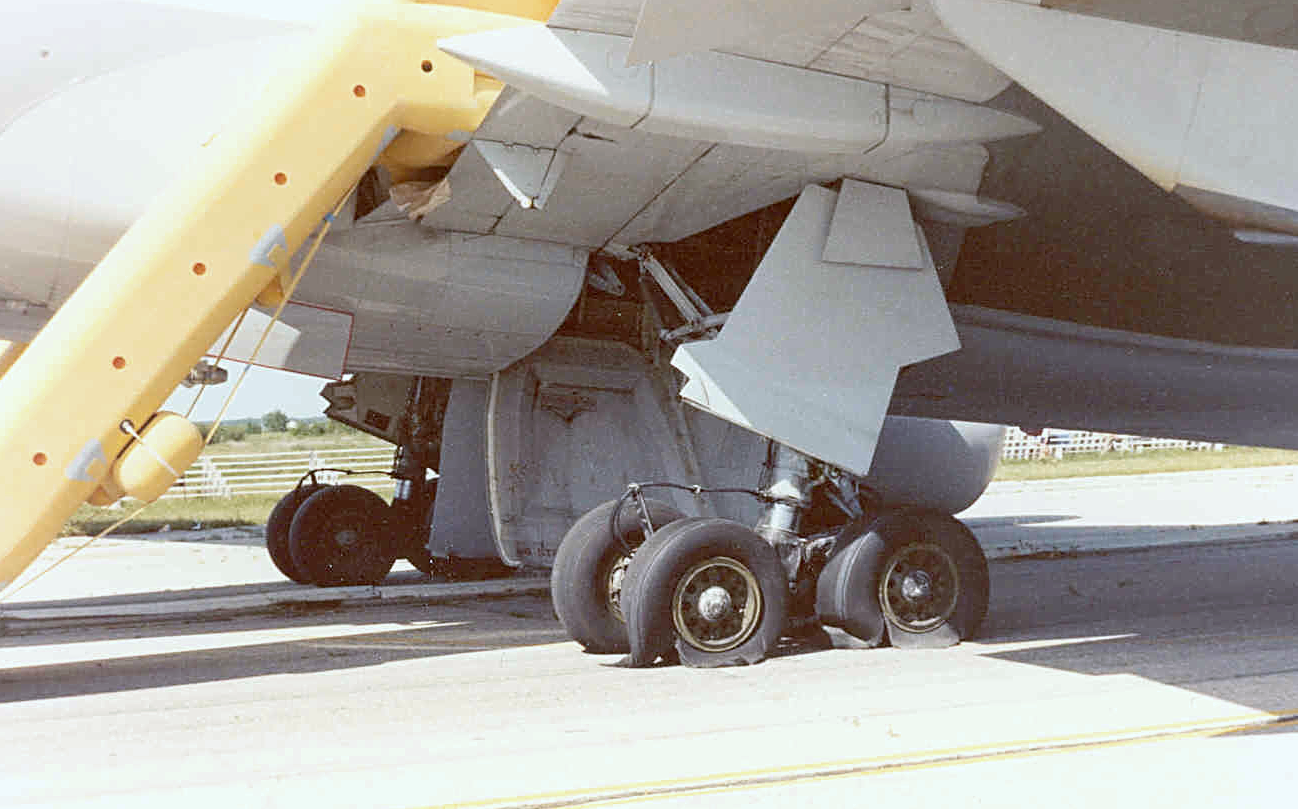
Figure - Damaged tires of Air Canada Flight 143 following the emergency landing at Gimli.
Implications for Airworthiness and Operations
The Gimli Glider incident demonstrates how multiple small deviations can align into a critical failure. From an airworthiness and operational perspective, several key themes emerge:
Configuration control: A mismatch between the aircraft’s actual configuration and its expected MEL condition introduced ambiguity into the crew’s decision to dispatch the aircraft.
Human factors: Interruptions, assumptions, and incomplete task execution played a central role in the event.
Unit standardization: The transition from imperial to metric units was not fully implemented across all operational practices.
Procedural dependency: Backup methods such as fuel drip rely on accurate execution and correct supporting calculations.
Broader Industry Context
At the time of the incident, the aviation industry was actively debating the extension of twin-engine operations beyond the long-standing 60-minute diversion limit. The introduction of aircraft such as the Boeing 767 had already triggered discussions between manufacturers and regulators regarding extended-range operations.
The Gimli Glider event introduced additional hesitation. While the aircraft itself demonstrated strong aerodynamic and system resilience, the incident highlighted vulnerabilities beyond engine reliability.
As explored in “From 60 Minutes to 370: Key Lessons from ETOPS History,” the central question was not limited to engines, but whether the entire operational system—design, maintenance, procedures, and human performance—could consistently support extended-range operations.
Boeing maintained that the event was unrelated to engine reliability, the core concern of ETOPS. Under the same circumstances, any aircraft—regardless of the number of engines—would have experienced fuel exhaustion.
In 1985, the Federal Aviation Administration issued Advisory Circular 120-42, formally introducing Extended-range Twin-engine Operational Performance Standards (ETOPS). This allowed twin-engine aircraft to operate up to 120 minutes from a suitable alternate airport, provided they demonstrated defined levels of reliability, maintenance control, and operational maturity.
Legacy and Preservation
The story of the Gimli Glider is preserved today by the Gimli Glider Museum. Supported by local residents, aviation enthusiasts, and original contributors, the museum displays authenticated aircraft parts, firsthand accounts, and memorabilia from the night of the emergency landing. The aircraft continued flying for Air Canada for over two decades, leaving a lasting mark on aviation history.
I would like to thank the Gimli Glider Museum for their generous support during the research for my book Aircraft Maintenance Programs (Springer, 2022), providing material to illustrate this case.
Closing Reflection
Air Canada Flight 143 remains a defining case in aviation safety. It illustrates that safety is not achieved through systems or procedures alone, but through the consistent alignment between them.
For airworthiness professionals, the lesson is clear: technical dispatch conditions, configuration control, and unit consistency must be supported by disciplined execution and clear understanding. Especially during periods of operational change, small deviations can combine into systemic failure.
The Gimli Glider did not challenge the future of extended operations—it helped clarify the conditions required to make them safe.
Learn to prevent small mistakes from becoming critical failures by mastering aircraft maintenance →
Author
David Lapesa Barrera is the founder of The Lean Airline® and author of The Lean Airline: Flight Excellence and Aircraft Maintenance Programs. His work focuses on lean management, operational excellence, and continuing airworthiness.