- Oct 21, 2025
From 60 Minutes to 370: Key Lessons from ETOPS History
- David Lapesa Barrera
Extended Diversion Time Operations (EDTO), formerly known as ETOPS, have shaped the way modern aviation approaches long-haul travel with twin-engine aircraft. But this evolution didn’t come without turbulence. Behind the regulatory milestones lies a story of cautious regulators, bold manufacturers, and incidents that nearly derailed its existence. Let’s look at the lessons learned from this fascinating journey.
From the 60-Minute Rule to Global Ambition
In 1936, the U.S. Bureau of Air Commerce introduced rules requiring twin-piston aircraft to remain within 100 miles of an alternate landing field. With an engine failure, this meant roughly 60 minutes of flight time. The rule, formalized in 1953, reflected the limited reliability of piston engines at the time.
Meanwhile, the International Civil Aviation Organization (ICAO) introduced more flexibility in the 1950s, recommending 90 minutes of diversion time for twin-engine aircraft. Some operators, like early Airbus A300 carriers, embraced these provisions and pushed their twinjets over oceans as early as the mid-1970s.
The Federal Aviation Administration (FAA), however, held firm. In 1964, it reaffirmed the 60-minute rule for twins, while freeing three- and four-engine aircraft from the same constraint. For decades, this meant that the tri- and quad-jets: DC-10s, L-1011s, 747s, and A340s dominated intercontinental routes.
By the early 1980s, the arrival of new-generation twinjets—Boeing 757/767, Airbus A300-600, A310, and later the A330—sparked calls for regulatory change. ICAO formed an ETOPS study group, recommending flexibility if aircraft could meet new reliability and operational standards. Boeing’s Director of Engineering even approached the FAA for a 767 exemption.
The Administrator’s sharp response became legend:
“It’ll be a cold day in hell before I let twins fly long haul, overwater routes.”
Despite this resistance, the regulatory dialogue had begun.
The Gimli Glider – A Close Call
On July 23, 1983, those discussions nearly came to an end. Air Canada Flight 143, a Boeing 767, infamously became the Gimli Glider when it ran out of fuel mid-flight and was forced to glide more than 45 miles to an abandoned airbase in Gimli, Manitoba.
The chain of errors leading to the incident was complex. Maintenance personnel left a circuit breaker improperly set, causing confusion about the aircraft’s fuel indication system. Dispatchers and flight crew misapplied a pounds-to-kilograms conversion, ultimately loading about half the required fuel. When both engines failed, all cockpit displays went blank, and only the crew’s skill enabled a safe landing. Miraculously, all 69 occupants survived.
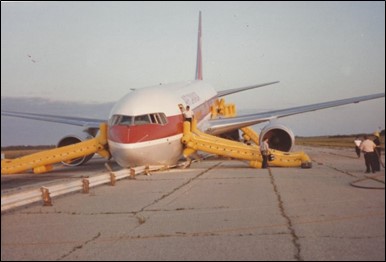
Figure - Gimli Glider evacuation.
For opponents of ETOPS, the incident was a red flag. If a highly modern twinjet could lose both engines in flight, how could regulators justify relaxing the 60-minute restriction? Boeing countered that the Gimli Glider wasn’t a failure of engine reliability—the core concern of ETOPS—but rather a fueling and human factors failure. A four-engine jet, Boeing argued, would have met the same fate under those circumstances.
The Birth of ETOPS
Despite initial reluctance, momentum shifted. In 1985, the FAA introduced Advisory Circular (AC) 120-42, allowing ETOPS operations up to 120 minutes for aircraft that met stringent reliability and operational requirements. That same year, Trans World Airlines (TWA) launched the first ETOPS-approved service with a Boeing 767.
Other civil aviation authorities soon followed, publishing their own guidance or adopting ICAO’s evolving Annex 6 provisions. By 1988, with solid operational experience, the FAA revised the rules (AC 120-42A), extending ETOPS to 180 minutes. Approval now required not only design and maintenance standards but also a minimum of 12 months of in-service experience. With 180 minutes, twinjets could cover over 90% of the Earth’s surface.
The success of ETOPS ushered in a new era. Tri- and quad-jets began to fade as airlines embraced the cost efficiency and flexibility of twin-engine long-haul operations.
Beyond Engines – A Wider View of Risk
But ETOPS history shows that safety in long-range operations isn’t just about engines. Air Transat Flight 236 in 2001—a transatlantic Airbus A330 that glided to the Azores after a massive fuel leak—proved that risks like undetected leaks, onboard fires, or sudden decompression are independent of engine count. What matters is proximity to diversion airports, sufficient oxygen supplies, and effective onboard firefighting systems.
Recognizing this, the FAA in 2007 extended ETOPS provisions to all passenger aircraft, including those with three and four engines, for diversions beyond 180 minutes. By then, ETOPS had become a universal benchmark for long-range operational safety.
The State of EDTO Today
Today, ETOPS has evolved into EDTO, reflecting a broader scope of operational considerations. Aircraft like the Airbus A350XWB have pushed boundaries further, achieving approvals for up to 370 minutes of diversion time. This means airlines can plan truly direct, ultra-long-haul routes across remote oceans and polar regions with confidence.
Key Lessons Learned
Reliability is earned, not assumed. The move from 60 minutes to 370 minutes was gradual, built on operational data and strict oversight.
Human factors matter as much as engineering. Incidents like the Gimli Glider highlight that procedures, training, and fuel management are just as critical as mechanical reliability.
Risk is multi-dimensional. Engines are vital, but fires, decompression, and medical emergencies are equally defining in diversion planning.
Regulation evolves with technology. What seemed unthinkable in the 1980s is now routine, thanks to data-driven decision-making and global collaboration.
From rigid 60-minute limits to 370-minute diversions, the evolution of EDTO is a testament to aviation’s ability to learn, adapt, and innovate. The flights that once shook its foundation ultimately reinforced it—laying the groundwork for safer, more efficient skies.
Learn the maintenance requirements behind ETOPS approval →
Author
David Lapesa Barrera is the founder of The Lean Airline® and author of The Lean Airline: Flight Excellence and Aircraft Maintenance Programs. His work focuses on lean management, operational excellence, and continuing airworthiness.