- May 19
Authorized Release Certificates: Ensuring Component Airworthiness
- David Lapesa Barrera
In aviation, the safety and airworthiness of aircraft rely on properly certified components. Whether new, overhauled, or repaired, every component installed on an aircraft must be accompanied by an official document verifying its compliance with regulatory standards. These documents, known as Authorized Release Certificates, provide assurance that a component is in serviceable condition and has been produced or maintained according to approved procedures. In Europe, this certificate is the EASA Form 1, while in the United States, the equivalent is the FAA Form 8130-3. Similar certificates exist under other aviation authorities, but these two are the most widely recognized internationally.
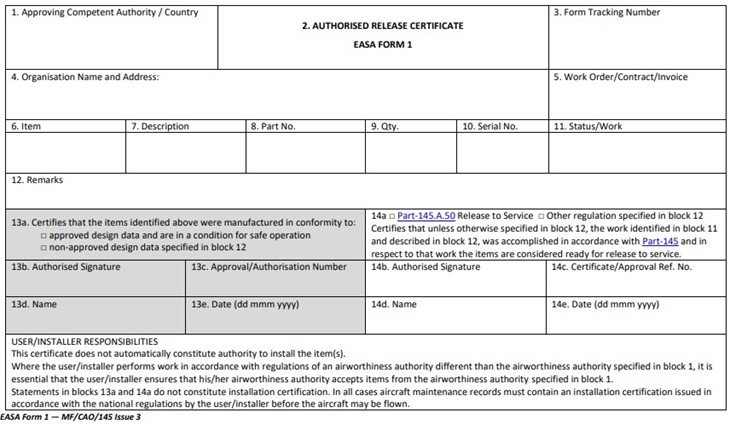
Figure - EASA Form 1 template (Part-145).
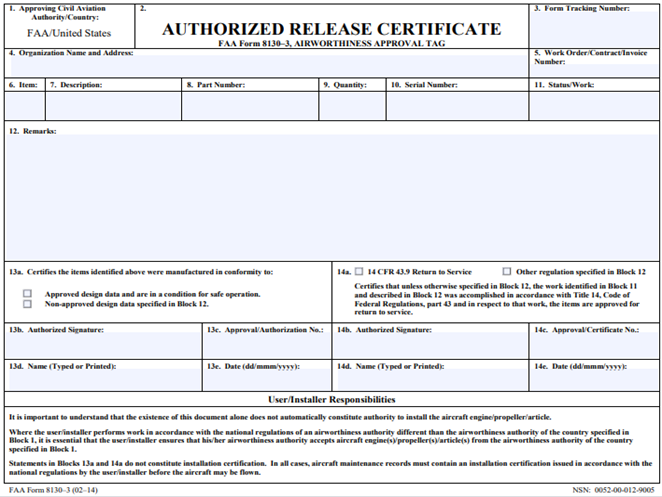
Figure - FAA Form 8130-3 template.
Purpose of Authorized Release Certificates
An Authorized Release Certificate serves as a formal declaration that a component is airworthy and suitable for installation on an aircraft. It guarantees that the component meets design and regulatory requirements and has undergone all necessary inspections and testing. Without such certification, the installation of any component on a certified aircraft would be non-compliant with aviation regulations and could compromise safety.
Authorized Release Certificates not only confirm that a component is compliant and serviceable but are also essential for back-to-birth traceability. This traceability is critical for life-limited parts, but also applies to other components, allowing operators to track each part from manufacture or maintenance, through installation and operational use, supporting maintenance planning, audits, and end-of-lease processes.
Issuance of EASA Form 1 and FAA Form 8130-3
Authorized Release Certificates can be issued under two main circumstances:
Production of New Components: Approved production organizations may release newly manufactured components with the appropriate certificate. For new parts, the certificate confirms identification, compliance with design specifications, and status as new or prototype.
Maintenance and Overhaul: Approved Part-145 maintenance organizations issue certificates for components that have been overhauled, repaired, tested, or modified. These certificates detail the component’s updated status, modifications performed, and readiness for return to service.
Maintenance should always be carried out by an approved organization, ensuring procedures comply with regulatory standards and are performed by trained personnel.
For a deeper look at how components are managed from removal, repair, and inspection to final acceptance and certification, see From Repair to Service: Aircraft Component Acceptance.
Key Information Included in an Authorized Release Certificate
An EASA Form 1, FAA Form 8130-3, or equivalent provides detailed information about the component and the basis for its release. This typically includes:
Component Identification: Part Number, Serial Number, and description.
Component Status: “New” or “Prototype” for new parts; “Overhauled,” “Inspected,” “Tested,” “Repaired,” or “Modified” for maintained components.
Remarks and Compliance Notes: Maintenance data used, compliance with Airworthiness Directives (ADs) and Service Bulletins (SBs), modifications or repairs performed, replacement parts installed, and life-limited part status.
This level of detail ensures traceability, accountability, and compliance with both design and operational standards. The certificate serves as a legal record for audits by aviation authorities or operators.
Certificates of Conformance
Not all parts require an authorized release certificate. Standard parts (e.g., fasteners, bearings, seals, pins) and raw or consumable materials (e.g., metals, plastics, lubricants, paints, sealants) must be accompanied by a Certificate of Conformance (CoC) or conformity statement verifying compliance with applicable standards.
For standard parts, a Form 1 or Form 8130-3 may be issued in lieu of a CoC, but this is generally not allowed for raw or consumable materials. Proper conformity documentation ensures every component and material meets quality and safety requirements, preventing the installation of substandard elements.
Suspected Unapproved Parts (SUP)
A critical risk in aviation is the presence of Suspected Unapproved Parts (SUPs). SUPs are components that appear not to meet regulatory requirements, including:
Parts lacking proper documentation.
Defective parts rejected during production.
Improperly maintained parts.
Military parts not certified for civil use.
Parts exceeding design life limits or damaged beyond repair.
Counterfeit or unauthorized supplier parts.
Indicators of SUPs include unusually low prices, unknown distributors, incomplete documentation, damaged packaging, or altered part identification numbers.
Installation of a SUP is strictly prohibited. Organizations must report SUPs to EASA or the FAA, as appropriate. Authorities investigate the part’s origin, determine safety implications, and ensure its removal from the aviation system if confirmed unapproved. Lists of SUPs and confirmed unapproved parts are published on EASA and FAA websites. Guidance is provided in EASA SIB 2017-13R1 and FAA AC 21-29D.
Regulatory Guidance and International Recognition
The completion of a Form 1 certificate is guided by EASA Part 21, Appendix I for production organizations and Part M, Appendix II for maintenance organizations. FAA Form 8130-3 is governed by FAA Order 8130.21G.
Under the EU-US Bilateral Aviation Safety Agreement (BASA), EASA and FAA recognize each other’s design approvals. New components from one regulatory environment may be installed in aircraft registered under the other when accompanied by the appropriate certificate. Used components require a dual-release certificate, referenced in designated boxes on the Form 1 or Form 8130-3.
Conclusion
Authorized Release Certificates, Certificates of Conformance, and the careful management of unapproved parts are critical to aviation safety. Proper documentation ensures components meet airworthiness standards, supports regulatory compliance, and protects the aircraft against installation of unauthorized or substandard parts.
Author
David Lapesa Barrera is the founder of The Lean Airline® and author of The Lean Airline: Flight Excellence and Aircraft Maintenance Programs. His work focuses on lean management, operational excellence, and continuing airworthiness.