- Nov 26, 2025
Inside or Outside? The Strategic Side of Outsourcing in Airlines
- David Lapesa Barrera
Outsourcing has become one of the most strategic decisions in modern airline management. As Peter Drucker famously said:
“Do what you do best and outsource the rest.”
The principle is simple: an organization should focus on the activities that define its core business and entrust other companies with tasks that, while necessary, do not directly contribute to its competitive advantage.
In the highly competitive and cost-sensitive aviation industry, this philosophy has shaped how airlines structure their operations. Outsourcing allows them to remain agile, reduce costs, and access specialized expertise. Yet, deciding what to outsource — and what to retain in-house — is far from straightforward.
A Strategic, Not Just Financial, Decision
The choice to outsource is often driven by a mix of strategic and operational factors. A helpful way to approach this decision is by analyzing two key dimensions:
Strategic importance of the activity, and
Internal capability or expertise to perform it effectively.
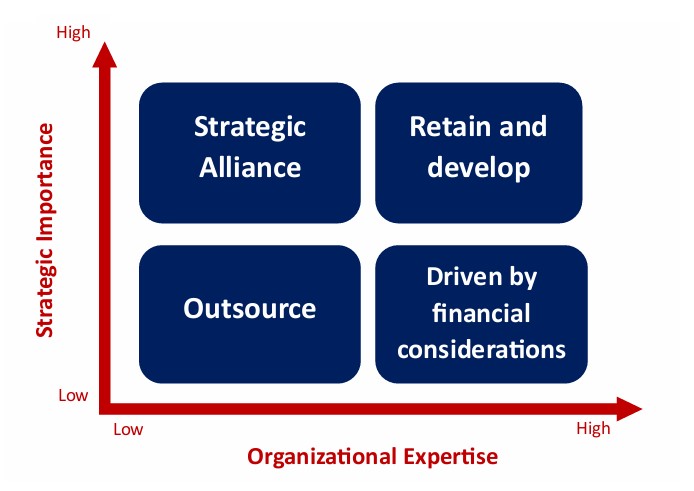
Figure - Outsourcing Decision Matrix.
Activities that are both strategically important and closely tied to the airline’s core competencies are best kept in-house. These typically include safety-critical or brand-defining operations, where control, quality, and reliability are paramount. Conversely, functions with lower strategic importance — and where external providers have greater expertise or economies of scale — are strong candidates for outsourcing.
While strategic alignment is the foundation, cost and quality remain decisive factors. Airlines must evaluate the full cost of performing an activity internally — including labor, equipment, facilities, and technology — and compare it to outsourcing alternatives.
However, the analysis should not stop at financial savings. Outsourcing can also enhance quality and performance when specialized partners bring innovation and excellence that the airline may not achieve alone.
Different Airlines, Different Approaches
The outsourcing landscape varies significantly depending on the size, maturity, and strategic focus of each airline.
Large network carriers often see aircraft maintenance and ground handling as core activities. These functions are deeply tied to safety, operational control, and reliability. Maintaining them in-house ensures alignment with company standards and facilitates continuous improvement under the airline’s own safety and quality management systems.
Smaller or regional operators, however, may view these same functions as support activities. For them, outsourcing maintenance or ground handling can offer access to specialized capabilities without the heavy infrastructure investment required for in-house operations. It allows flexibility, scalability, and a variable cost structure that aligns better with fluctuating demand.
Catering is another good example. While inflight service is a direct contributor to the passenger experience and brand perception, many airlines outsource catering to specialized providers. This enables them to reduce operating costs, ensure consistent quality, and adapt their menus and products more easily to different markets and service classes.
A growing trend is also seen in the outsourcing of continuing airworthiness management tasks. By delegating these complex and highly regulated administrative functions, smaller operators can focus on their operational core while ensuring compliance and technical oversight through certified external partners.
The Benefits and Risks of Outsourcing
When implemented thoughtfully, outsourcing can deliver clear benefits:
Cost efficiency through specialization and economies of scale
Access to expertise and advanced technology
Flexibility to scale operations up or down with demand
Focus on core business and strategic priorities
However, these advantages come with inherent risks. Reduced control, communication challenges, and dependency on external providers can impact performance if not properly managed. The quality and reliability of outsourced services directly influence the airline’s reputation and regulatory compliance. Therefore, outsourcing cannot simply be treated as a procurement exercise — it is a strategic partnership that requires robust oversight.
Managing Outsourcing the Lean Way
The Lean philosophy provides a useful perspective for managing outsourcing effectively. Lean emphasizes value, flow, and waste reduction — principles that apply equally to internal and external processes. Airlines should ensure that outsourcing decisions enhance value for the passenger and the organization as a whole.
This means establishing clear Service Level Agreements (SLAs), setting measurable performance indicators, and maintaining open communication between the airline and its partners. Continuous improvement must remain a shared goal, not just a contractual obligation. Outsourcing works best when both parties collaborate as one system focused on safety, efficiency, and customer satisfaction.
Conclusion
Outsourcing in airlines is not about relinquishing control — it is about optimizing value. The decision must be guided by strategy, supported by data, and reinforced by strong partnerships. What matters most is not who performs the task, but how effectively it contributes to the airline’s overall performance and its ability to deliver safe, efficient, and reliable service to passengers.
In the end, success lies in finding the right balance: doing what you do best, outsourcing what others can do better, and ensuring that both sides work together as part of one seamless, value-driven operation.
Learn how airlines structure and manage their operations →
Author
David Lapesa Barrera is the founder of The Lean Airline® and author of The Lean Airline: Flight Excellence and Aircraft Maintenance Programs. His work focuses on lean management, operational excellence, and continuing airworthiness.