- Mar 25, 2025
MSG-3 Analysis (Part IV): Protecting Aircraft from Lightning and Radiated Fields (L/HIRF)
- David Lapesa Barrera
Aircraft operate in environments where lightning strikes and electromagnetic radiation are common occurrences. While aircraft are designed with robust protection systems, degradation of protection components over time could increase the risk of electrical or electronic system failures if not properly monitored.
Within the Maintenance Steering Group-3 (MSG-3) methodology, L/HIRF analysis focuses on ensuring that protection against lightning and high-intensity radiated fields remains effective throughout the aircraft’s operational life. The analysis evaluates how environmental or accidental damage could affect protection systems and identifies maintenance tasks to preserve their effectiveness.
The resulting tasks contribute to the maintenance requirements included in the Maintenance Review Board Report (MRBR), supporting the development of the Aircraft Maintenance Program used by operators.
In this article, we explore the MSG-3 analysis process for L/HIRF protection, from identifying significant protection items to defining the maintenance tasks needed to ensure continued airworthiness.
Key Components of L/HIRF Protection
L/HIRF protection relies on both internal and external protection components:
Internal Protection Components: For Line Replaceable Units (LRUs) equipped with internal protection components, the aircraft manufacturer ensures that the LRU manufacturer validates the effectiveness of the protection. This may be confirmed through LRU Component Maintenance Manual procedures or other regulatory-accepted data. In this scenario, MSG-3 analysis is not required.
External Protection Components: External L/HIRF protection components must undergo analysis if their failure could affect safety. The Type Certificate Holder (TCH) may combine Zonal and L/HIRF assessments when appropriate. All findings should be reflected in the Policy and Procedures Handbook (PPH).
MSG-3 Analysis Procedure for L/HIRF Protection
The majority of L/HIRF protection maintenance is typically covered by zonal inspections. However, when Zonal Inspections fail to detect degradation of L/HIRF protection components, additional tasks are necessary.
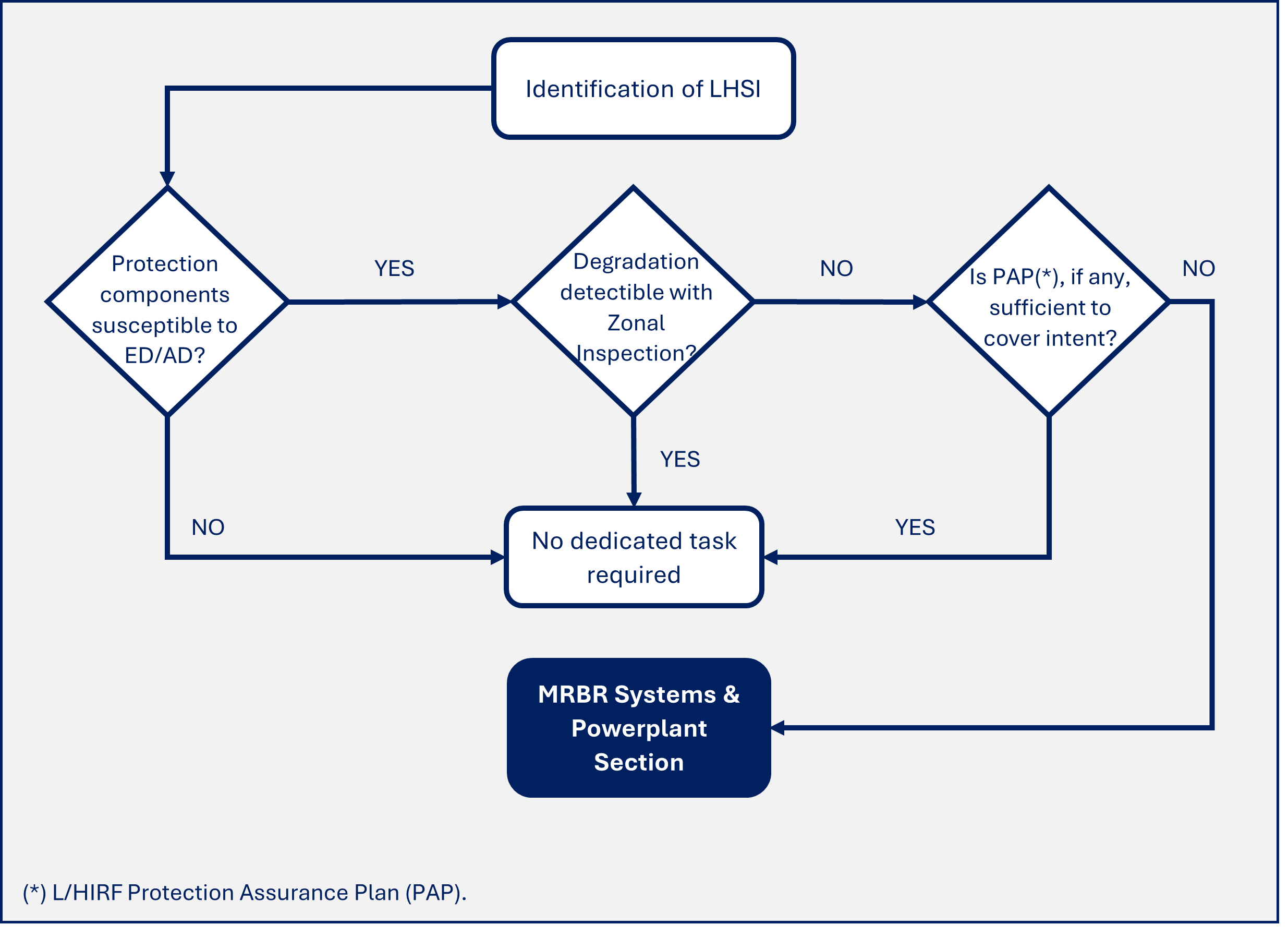
Figure — Simplified MSG-3 L/HIRF Analysis. Source: Aircraft Maintenance Programs (Lapesa Barrera, 2022).
Step 1: Identifying Significant L/HIRF Items (LHSI)
The first step in the MSG-3 analysis is to identify L/HIRF Significant Items (LHSI). These items perform critical functions essential to ensuring L/HIRF protection for key systems and structures. Dedicated L/HIRF maintenance is only required for components susceptible to Environmental or Accidental Damage (ED/AD).
Step 2: Assessing Degradation
For each location where LHSIs are installed, ED/AD threats are evaluated:
If degradation is detectable through Zonal Inspections, no further dedicated L/HIRF maintenance is required.
-
If degradation isn’t covered by Zonal Inspections:
If degradation is detectable without disassembly, the appropriate task and interval are selected.
If disassembly is needed, the potential effects of disassembly must be weighed against the likelihood of degradation.
Based on this assessment, the required tasks are determined, and if disassembly would cause further damage or deterioration, redesign may be necessary.
Step 3: L/HIRF Protection Assurance Plan (PAP)
The Working Group reviews the L/HIRF Protection Assurance Plan (PAP) developed by the Type Certificate Holder (TCH). This includes sample size, test points, and other details to determine if the existing plan covers the task requirements. If additional stand-alone tasks are necessary, these are identified and incorporated into the maintenance schedule.
Conclusion
By following MSG-3 analysis for L/HIRF protection, aircraft manufacturers can ensure that lightning strikes and radiated fields do not compromise airworthiness. The inclusion of L/HIRF tasks under ATA 20 Standards Practices—Airframe provides an organized approach to maintaining aircraft safety, minimizing risks from L/HIRF threats, and ensuring effective airframe protection.
Learn more about MSG-3 analysis and Aircraft Maintenance Program development →
MSG-3 Series — Next: Part V – Aircraft Health Monitoring (AHM) →
Author
David Lapesa Barrera is the founder of The Lean Airline® and author of The Lean Airline: Flight Excellence and Aircraft Maintenance Programs. His work focuses on lean management, operational excellence, and continuing airworthiness.