- Mar 4, 2025
The MRB Process Made Simple: Key Insights for Airworthiness Professionals
- David Lapesa Barrera
The continuing airworthiness of an aircraft begins with meeting the requirements established during its certification, followed by the minimum scheduled maintenance requirements necessary for developing an approved Aircraft Maintenance Program (AMP).
The primary sources for an AMP include the type design certification requirements - Airworthiness Limitations (ALS) and Certification Maintenance Requirements (CMR) - and the initial scheduled maintenance tasks outlined in the Maintenance Review Board Report (MRBR).
Here’s a breakdown of what you need to know about the MRB process, its standards, and its role in the development of initial maintenance programs for newly certified aircraft and engines.
The Maintenance Review Board (MRB) Process
So, who actually kicks off the MRB process?
The MRB process begins with the application from the intended Type Certificate Holder (TCH), an approved design organization, and it primarily involves the certification authority of the aircraft's state of design, along with representatives from the aviation industry, including air operators. Additionally, regulatory authorities from the states of intended operation, other design organizations, and other interested parties may also participate in the process to ensure comprehensive review and compliance.
A key element of the MRB process is the use of the MSG-3 methodology, which is a task-oriented approach to determine maintenance tasks and intervals.
The Role of the International Maintenance Review Board Policy Board (IMRBPB)
The standards for the MRB process at the highest level are outlined in the ICAO Airworthiness Manual Doc 9760. Following this manual, the International Maintenance Review Board Policy Board (IMRBPB) issues the International MRB Process Standard (IMPS), ensuring harmonization across certification bodies.
The International Maintenance Review Board Policy Board (IMRBPB) consists of aviation regulatory authorities and industry representatives. Its main objective is to develop procedures and guidance on the MRB process and the use of the MSG-3 methodology. The board meets annually to discuss and standardize the MRB process.
It includes members from major regulatory authorities, including Australia, Canada, the EU, the US, and more. Industry representatives from organizations like the MPIG (Maintenance Programs Industry Group) also play a key role. The IMRBPB's positions become policy only when are adopted by the corresponding regulatory authority.
The International MRB Process Standard (IMPS)
The IMRBPB issues the International MRB Process Standard (IMPS) as guidance to standardize the processes and procedures to be used by the regulatory authorities in the oversight and approval of scheduled maintenance requirements.
The International MRB Process Standard (IMPS), written in compliance with the ICAO MRB requirements, defines the detailed procedures for developing scheduled maintenance requirements for larger aircraft (over 15,000 kg). Although recommended for larger aircraft, the MRB process may be applied to smaller aircraft if the applicant chooses to do so.
Key Players in the MRB Process
The MRB process is carried out by various bodies, each with specific roles:
MRB (Maintenance Review Board): Responsible for approving the MRBR under the guidance of the MRB Chairperson. The MRB oversees the process, ensures proper training, and approves the final MRBR.
TCH (Type Certificate Holder): Applies for the MRB process and provides the necessary technical data. The TCH also develops the Policy and Procedures Handbook (PPH), which guides the working groups (WG) through the process.
ISC (Industry Steering Committee): This body manages the working groups, prepares the MRBR, and ensures all necessary technical and maintenance data is presented to the MRB for review.
MWG (Maintenance Working Groups): Specialists from various areas, including the applicant, operators and maintenance organizations, review the MSG-3 analysis and propose maintenance tasks and intervals based on technical data.
The output of the MRB process is the Maintenance Review Board Report (MRBR), which establishes the minimum scheduled maintenance requirements to be used in the development of an approved Aircraft Maintenance Program (AMP).
The MSG-3 methodology is used to propose maintenance tasks and intervals, which are reviewed by the Industry Steering Committee (ISC). Once finalized, the MRBR is submitted to the MRB for approval.
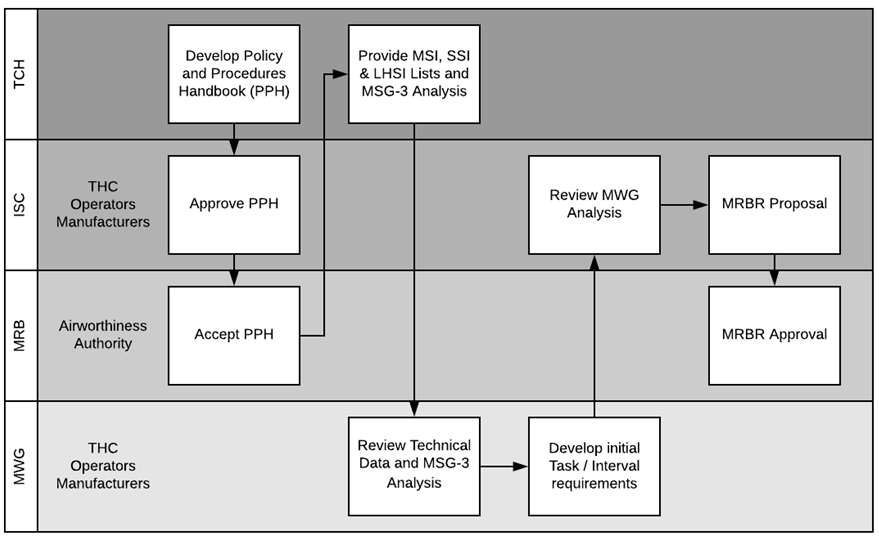
Figure — MRB Process. Source: Aircraft Maintenance Programs (Lapesa Barrera, 2022).
Operators play a key role in the Industry Steering Committee (ISC) and Maintenance Working Groups (MWG). This process isn’t just about collaboration—it’s about influencing decisions that directly impact operational efficiency and costs.
Note: The MSG-3 methodology classifies aircraft systems and structures based on their maintenance and safety significance. Categories such as MSI (Maintenance Significant Item), SSI (Structural Significant Item), and LHSI (Lightning/HIRF Significant Item) are used to guide the maintenance analysis and task development process.
The Policy and Procedures Handbook (PPH)
The Policy and Procedures Handbook (PPH) is the project-specific document that defines how the MRB process will be conducted for a particular aircraft type. It serves as the essential guide for developing the initial minimum scheduled maintenance and inspection requirements. The PPH consolidates all relevant standards, including the IMPS and MSG-3, adapted to the specific aircraft program.
Any deviations from the standard process must be approved by the competent authority and reflected in the PPH.
Utilization Considerations
The MSG-3 analysis as a whole assumes an anticipated average annual utilization of the aircraft. Task intervals are determined in function of this assumption and are valid for the defined utilization envelope.
The utilization envelope is reflected in the PPH and the MRBR. When the utilization falls out of the utilization envelope defined in the MRBR, the Type Certificate Holder is responsible for developing specific recommendations, such as Low Utilization Recommendations (LUR).
Conclusion
The MRBR defines the initial scheduled maintenance tasks that form the foundation of Aircraft Maintenance Programs. Developed during the aircraft certification phase through the MSG-3 methodology and industry collaboration, these requirements establish the baseline maintenance needed to support continuing airworthiness.
Understanding this process allows airworthiness professionals to better interpret the logic behind maintenance tasks and manage maintenance programs more effectively throughout the operational life of the aircraft.
Learn more about Aircraft Maintenance Program development →
Author
David Lapesa Barrera is the founder of The Lean Airline® and author of The Lean Airline: Flight Excellence and Aircraft Maintenance Programs. His work focuses on lean management, operational excellence, and continuing airworthiness.