- Jun 9
Airworthiness and Crashworthiness: Two Sides of Aviation Safety
- David Lapesa Barrera
When we talk about aviation safety, airworthiness is usually the starting point. It defines whether an aircraft is fit to fly, compliant with design standards, and maintained within approved limits. But airworthiness alone does not tell the full story of safety. Beneath it sits another critical dimension that is often less visible but equally important: crashworthiness.
In practice, airworthiness and crashworthiness are not separate worlds. They are connected layers of the same system. One is designed to prevent failure in flight. The other is designed to manage the consequences when prevention is no longer possible.
Airworthiness: preventing the undesired state
Airworthiness is built on a simple principle: the aircraft must not enter an unsafe condition during its operational life. This includes structural integrity, system reliability, compliance, and operational limits defined by regulators and manufacturers.
Airworthiness is about stability and standardization. It reduces variation in design, maintenance, and operation. It ensures that known risks are controlled through certification, inspection, and continuous oversight.
However, airworthiness operates within assumptions. It assumes correct usage, timely maintenance, and predictable operating environments. In reality, aviation is a complex system where human factors, environmental conditions, and rare failures can still align in unexpected ways. This is where the boundary of airworthiness ends—and crashworthiness begins.
Crashworthiness: designing for the moment of failure
Crashworthiness addresses what happens when the system leaves its normal operating envelope. It focuses on survivability: how the structure behaves during impact, how energy is absorbed, how occupants are protected, and how post-impact risks such as fire are managed.
It shifts the question from “Can we prevent this accident?” to “If it happens, how do we reduce harm?”
Rather than being a single design feature, crashworthiness is best understood as a set of interacting survivability conditions. One way to structure these conditions in accident investigation and safety analysis is through the CREEP framework:
Container refers to the aircraft structure itself. The fuselage must maintain a survivable space during impact, avoiding excessive collapse, intrusion, or penetration from external objects.
Restraints include seat belts, attachments, and connectors designed to keep occupants secured under crash loads and prevent secondary injuries caused by uncontrolled movement.
Energy absorption focuses on how crash forces are managed and distributed. The aircraft structure and seating system play a key role in reducing the deceleration forces transmitted to occupants.
Environment considers everything inside the cabin or cockpit. Loose objects or improperly secured equipment can become hazardous during impact, turning survivable crashes into fatal events.
Post-crash factors address survivability after impact, including evacuation capability, access to exits, and exposure to fire, smoke, and toxic fumes.
Together, these elements show that crashworthiness is not a single attribute, but a system of conditions that collectively determine whether survival is possible after an accident.
Where airworthiness and crashworthiness meet
The connection between both concepts becomes clear when we look at system boundaries. Airworthiness ensures the aircraft performs within its design envelope. Crashworthiness defines what happens when that envelope is exceeded.
A well-designed aircraft does not treat crashworthiness as an afterthought. Instead, it integrates it into structural and systems design from the beginning. For example, fuselage sections are engineered not only for pressurization and fatigue life but also for controlled breakup patterns in extreme loads. Seats are certified not only for comfort and operational use, but for survivability under crash deceleration forces.
This integration reflects a broader safety philosophy: preventing accidents is essential, but preparing for their consequences is equally part of responsible design.
Crashworthiness is not only defined at the design stage. Operators also play a critical role in preserving it throughout the aircraft’s operational life. Cabin configuration, securing of equipment, maintenance of restraint systems, and adherence to operational procedures all influence whether crashworthiness assumptions hold in real conditions. In this sense, operators act as the link between certified design intent and real-world survivability performance.
The Boeing 720 controlled impact demonstration
A clear illustration of this connection can be seen in the Controlled Impact Demonstration conducted in 1984 using a remotely piloted Boeing 720. The aircraft was deliberately crashed at Edwards Air Force Base in a joint NASA and FAA experiment designed to study crashworthiness, particularly post-impact fire behavior.
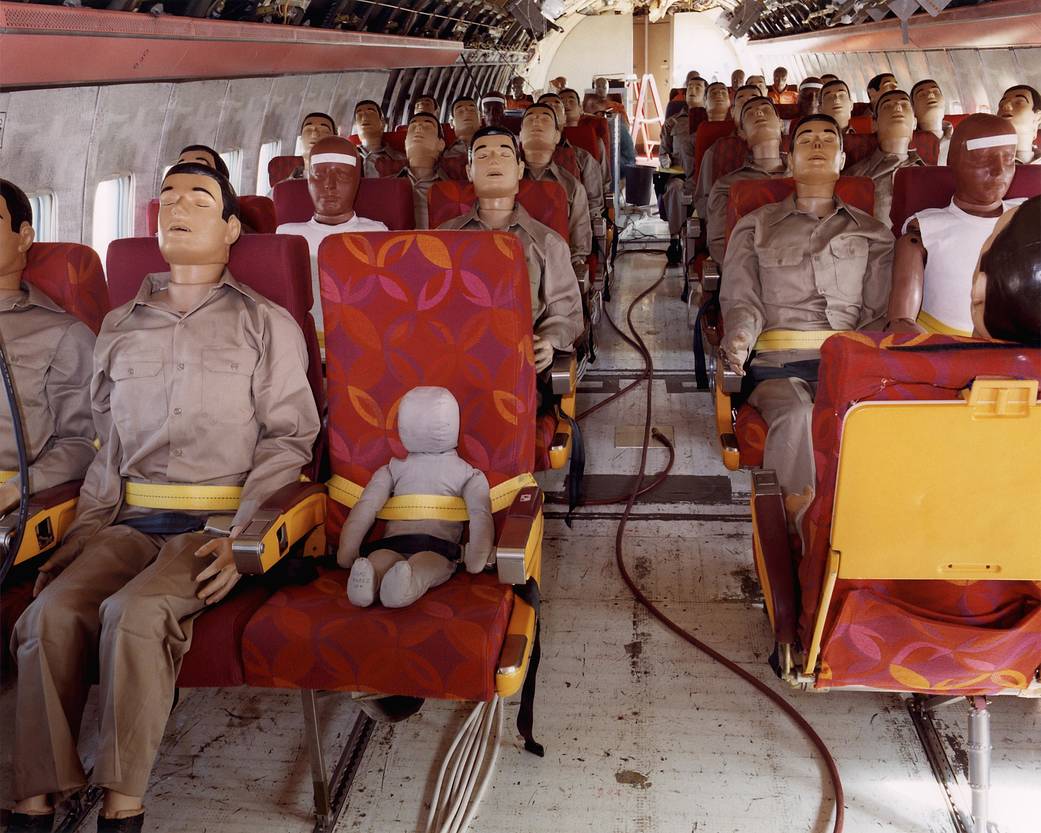
Figure - Test dummies in the passenger cabin of the B-720 aircraft.
The objective was to understand how fuel systems and structural breakup contributed to survivability outcomes. A key focus was the use of anti-misting kerosene (AMK), a fuel additive intended to reduce fire risk after impact.
The results showed that while the aircraft structure provided valuable data on impact breakup and deceleration, the AMK system did not perform as expected, and a significant post-crash fire still developed. This reinforced a critical insight: even when structural survivability is improved, secondary effects such as fire can dominate fatality risk.
The demonstration highlighted that crashworthiness cannot be evaluated through structure alone. The full sequence—from impact forces to fuel behavior to post-crash conditions—must be considered together.
A continuous safety perspective
Airworthiness and crashworthiness must be seen as parts of a continuous safety chain rather than isolated disciplines. One governs safe operation within limits; the other governs survivability beyond those limits.
Airworthiness reduces the probability of failure during operation.
Crashworthiness reduces the severity of consequences when failure occurs.
The transition between them is not a clean break but a gradient. Every design decision made in the name of airworthiness influences crashworthiness outcomes, and vice versa.
Closing thought
Aviation safety is often described as the absence of accidents. But in reality, it is the presence of multiple overlapping safeguards.
Airworthiness keeps the aircraft in its intended state. Crashworthiness prepares it for when it is not.
Together, they form a single logic: not only to keep aircraft flying safely, but to ensure that if the system fails, it fails in a way that still protects human life.
Learn more about how airworthiness is maintained in practice across the aircraft lifecycle →
Author
David Lapesa Barrera is the founder of The Lean Airline® and author of The Lean Airline: Flight Excellence and Aircraft Maintenance Programs. His work focuses on lean management, operational excellence, and continuing airworthiness.