- May 13, 2025
MSG-4: Leveraging Aircraft Health Monitoring for Condition-Based Maintenance
- David Lapesa Barrera
The transition from MSG-3 to MSG-4 will mark a crucial shift in aircraft maintenance practices, particularly with the integration of Aircraft Health Monitoring (AHM).
In the MSG-3 standard, AHM is limited to non-safety tasks, provided these tasks do not cover Candidate Certification Maintenance Requirements (CCMRs). While AHM can offer alternative procedures to classic maintenance tasks, a classic task selection is still required.
The recommendations for MSG-4, however, takes a more forward-thinking approach by enhancing existing MSG processes and workflows. Rather than treating AHM as a standalone analysis, MSG-4 proposes integrating AHM throughout the entire maintenance strategy. This shift aims to rethink the design of health monitoring systems, expanding their scope to support the full aircraft lifecycle. The goal is to eliminate the need for selecting classic tasks by integrating AHM as a form of Condition-Based Maintenance (CBM), enabling maintenance decisions to be driven by real-time data.
Maintenance Approaches
Maintenance can be broadly classified into reactive and proactive.
Reactive maintenance, often called run-to-fail, involves fixing equipment only after it breaks. It can lead to unexpected downtime and higher repair costs.

Figure 1. Maintenance Approaches
Proactive maintenance, on the other hand, aims to prevent failures before they occur. It includes preventive maintenance, where tasks are scheduled at regular intervals based on time or usage, and predictive, which relies on aircraft data to assess an asset's condition. Predictive maintenance can be either diagnostic (responding to detected issues) or prognostic (predicting failures in advance), allowing maintenance to be performed only when needed. This makes it more efficient and resource-effective, though it requires monitoring technology. Condition-Based Maintenance falls under the proactive maintenance category.
Condition-Based Maintenance (CBM)
Condition-Based Maintenance (CBM) is a methodology that continuously monitors an asset’s condition to determine when maintenance is required. Unlike traditional time-based maintenance, CBM triggers maintenance actions only when performance indicators suggest a decline in functionality or signs of an impending failure. This approach is more efficient, as it allows maintenance to be performed only when necessary, reducing unnecessary work and ensuring resources are used effectively.
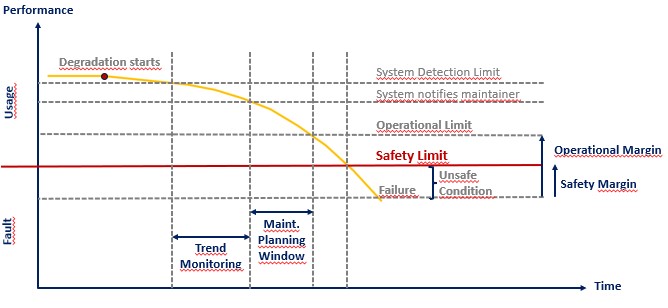
Figure 2. CBM for Systems
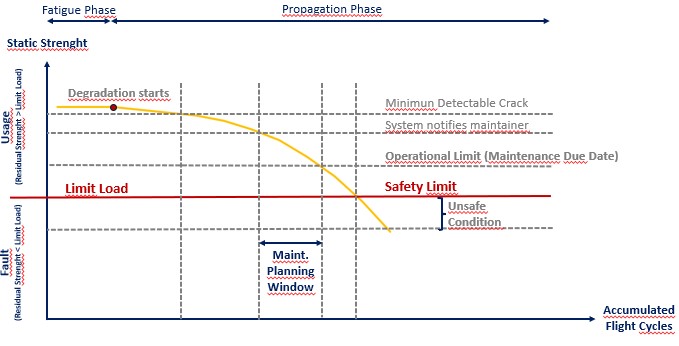
Figure 3. CBM for Structures
CBM does not always rely on real-time monitoring. In some cases, the condition data might be gathered periodically or through intervals based on specific needs, rather than continuously in real time. For example, certain indicators, such as an oil sample analysis, may be assessed only during scheduled inspections or when specific thresholds are met. This approach can sometimes delay the identification of issues until the next evaluation point.
To ensure MSG-4 is future-proof and ready for emerging technologies, it is recommended that a review be conducted to evaluate all possible CBM applications within the system. This review should aim to fully integrate emerging and future technologies into the workflow, ensuring that MSG-4 remains adaptable and capable of leveraging the latest innovations in aircraft health monitoring. By aligning with the future of aviation technology, MSG-4 can drive not only improved efficiency but also increased reliability and safety across the aircraft’s lifecycle.
Conclusion
The integration of Aircraft Health Monitoring (AHM) into MSG-4 represents a pivotal evolution in maintenance strategy, shifting from traditional scheduled tasks to more intelligent, data-driven decision-making, enabling Condition-Based Maintenance (CBM).
Learn more about MSG-4 and Condition-Based Maintenance →
Further Reading
Recommendations for the Development of MSG-4 – Airlines for America
Condition-Based Maintenance (CBM) in the Digital Transformation Stream – International Council of the Aeronautical Sciences, 32nd Congress
Condition Based Maintenance Plus (CBM+), Guidebook – U.S. Department of Defense
From Aircraft Health Monitoring to Aircraft Health Management – IATA White Paper on AHM
Author
David Lapesa Barrera is the founder of The Lean Airline® and author of The Lean Airline: Flight Excellence and Aircraft Maintenance Programs. His work focuses on lean management, operational excellence, and continuing airworthiness.