- Feb 3
CMR (Part I): Understanding Certification Maintenance Requirements and System Safety Analysis
- David Lapesa Barrera
Aircraft safety depends not only on design and manufacturing but also on the systematic application of maintenance throughout an aircraft’s life. Certification Maintenance Requirements (CMRs) are a key part of this process. ICAO defines a CMR as:
“The scheduled maintenance required by design to help show compliance with the appropriate type certification basis by detecting the presence of a safety-significant latent failure that would result in a hazardous or catastrophic failure condition.”
In practice, CMRs are mandatory scheduled maintenance tasks established during the design certification of aircraft systems. They are identified during the certification process as a subset of the Instructions for Continued Airworthiness (ICA) and are approved as airworthiness limitations within the Type Certificate (TC) or Supplemental Type Certificate (STC).
CMRs are therefore functionally equivalent to other Systems Airworthiness Limitations (such as Fuel Airworthiness Limitations for fuel systems) and are enforced through Airworthiness Directives (ADs).
In this article, we will explore what CMRs are, how they are developed, and why they are essential for safe flight operations.
Understanding CMRs
CMRs are repetitive maintenance tasks established during the type certification or supplemental type certification process, or whenever a major modification affects a certified system. They are designed to detect failures that could compromise safety, including:
latent failures that may lead to hazardous or catastrophic failure conditions,
latent failures that may result in a major failure condition when the System Safety Analysis (SSA) identifies the need for a scheduled maintenance task, and
impending wear-out of items whose failure could have hazardous or catastrophic consequences.
Standards for the CMR process are set in regulatory guidance, such as EASA AMC 25.1309 and AMC 25-19, and FAA AC 25.1309-1A and AC 25-19A.
Failure Probability and Its Role
The identification and prioritization of Certification Maintenance Requirements (CMRs) depend on both the probability of system failures and their potential consequences. Failure conditions are typically classified into four categories, with both quantitative and qualitative perspectives:
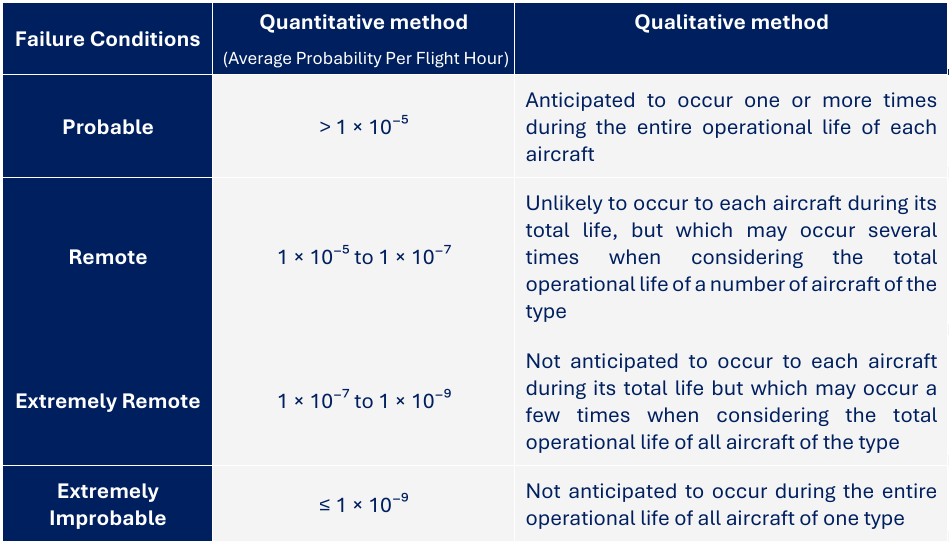
Failure conditions probability in quantitative and qualitative methods.
Understanding both the numerical probabilities and qualitative likelihood ensures that maintenance resources are focused where safety risks are greatest.
CMRs and System Safety Analysis
A Standard System Safety Analysis (SSA) provides the foundation for establishing Certification Maintenance Requirements (CMRs). This analysis identifies safety-significant latent failures in aircraft systems and components. Candidate Certification Maintenance Requirements (CCMRs) are the initial proposed maintenance tasks that emerge from this SSA process, before formal review and approval.
Standard System Safety Analysis (SSA) Process
The SSA is performed by the Type Certificate (TC) or Supplemental Type Certificate (STC) applicant/holder and can be summarized in six main steps:
1. Define the System and Its Functions
Identify the system, its interfaces, and the intended functions it must perform.
2. Identify and Classify Failure Conditions
Perform a Functional Hazard Assessment (FHA) to systematically examine aircraft and system functions and identify potential failure conditions.
Non-complex systems: Classification may rely on design and installation reviews and service experience from similar systems.
Complex systems: Systematically postulate the effects of any possible failure on the aircraft and its occupants.
3. Determine Failure Condition Probabilities
Use quantitative and qualitative methods to classify failure conditions
4. Select Depth and Scope of Analysis
Determine the analysis depth based on system functions, severity of failure conditions, and system complexity.
5. Conduct the Analysis
Perform the systematic safety evaluation and collect data on potential failures.
6. Assess and Compile Results
Evaluate the analysis and conclusions of multiple safety assessments.
Prepare compliance statements, maintenance requirements (CCMRs), and any necessary flight manual instructions.
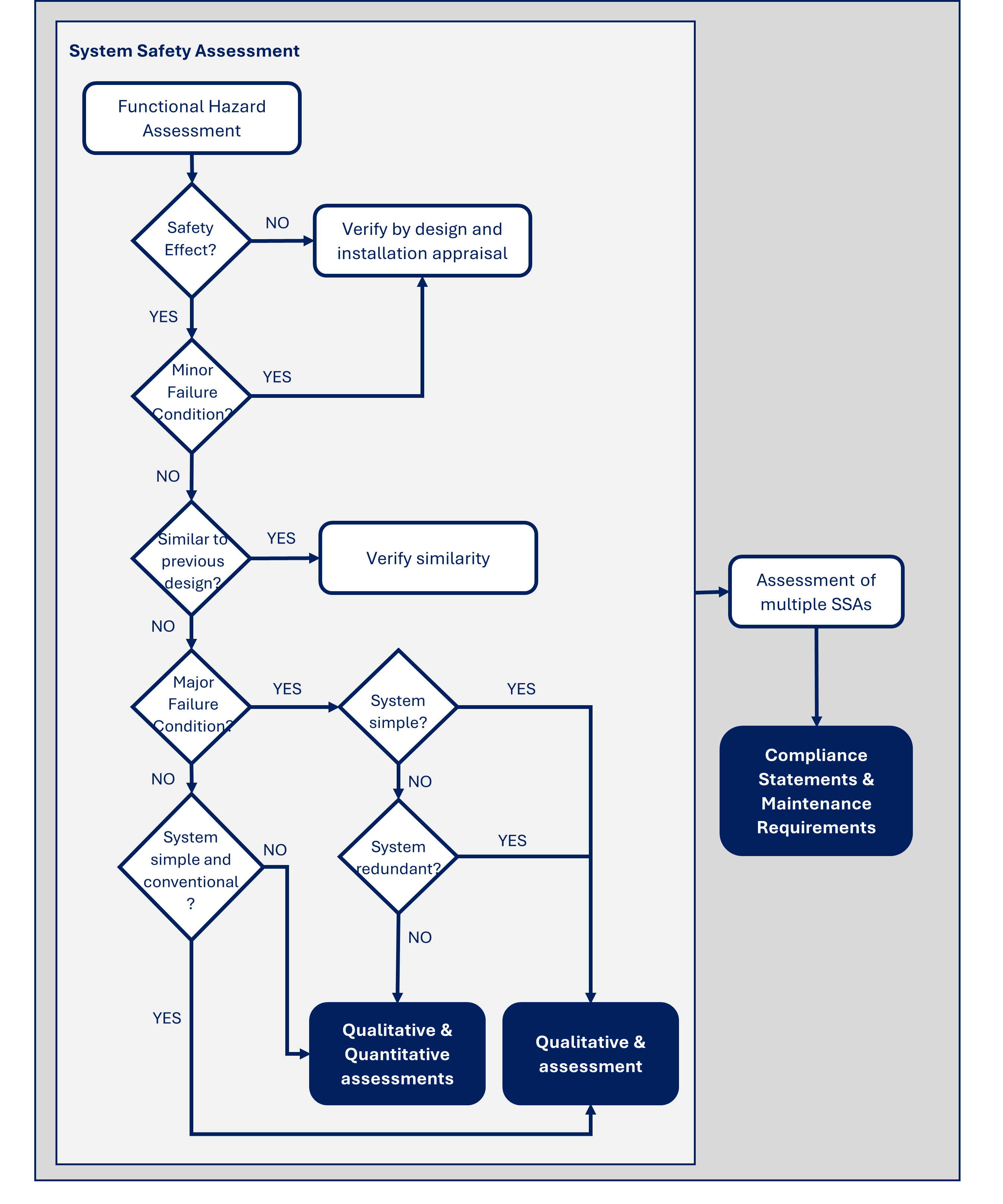
System Safety Analysis (SSA) (simplified)
Conclusion
Certification Maintenance Requirements (CMRs) are one of several mechanisms that ensure compliance with the type certification basis, alongside other Airworthiness Limitations and Airworthiness Directives (ADs) that enforce them. CMRs ensure that aircraft systems continue to operate safely throughout their service life. By identifying safety-significant latent failures, they link the systems design certification process with scheduled maintenance.
Learn more about Certification Maintenance Requirements (CMRs) →
Next: Part II – Coordinating, categorizing, and managing CMR →
Author
David Lapesa Barrera is the founder of The Lean Airline® and author of The Lean Airline: Flight Excellence and Aircraft Maintenance Programs. His work focuses on lean management, operational excellence, and continuing airworthiness.