- Jun 24, 2025
Case Study: Overdue Airworthiness Directive – A Chain of Human and Organizational Factors
- David Lapesa Barrera
Airworthiness Directives (ADs) are essential to maintaining aircraft safety. They mandate corrective actions such as modifications, part replacements, inspections, or changes to operational procedures in response to identified unsafe conditions. However, even when issued, their effectiveness depends on timely and accurate compliance. This case study explores how a failure to comply with an AD — due to a breakdown in communication, oversight, and coordination — led to grounded aircraft and operational disruption. This costly oversight also illustrates how human factors and systemic weaknesses contributed to the situation, analyzed through the Dirty Dozen and HFACS frameworks.
Chain of Events
A Type Certificate Holder (TCH) issued a modification Service Bulletin (SB), which was assessed and scheduled for gradual implementation — on an attrition basis — by the technical services function of the engineering and maintenance organization. There was no related Airworthiness Directive (AD), the SB was not mandatory.
At around the same time, the TCH also published a revised Airworthiness Limitations Section (ALS) document. This version introduced a new section on Widespread Fatigue Damage (WFD)-related mandatory modifications, now with a compliance deadline.
The requirement to embody a mandatory modification through the ALS documentation is an unusual procedure; typically, it is mandated through an Airworthiness Directive.
An experienced maintenance programs engineer reviewed the ALS but assumed that, because the content resembled the earlier SB, the requirement would eventually be covered by an Airworthiness Directive (AD). Believing the SB (and thus the new ALS section) remained under technical services’ scope, the engineer took no further action.
This misjudgment was not caught:
A second engineer failed to flag the missing implementation during cross-checks.
The supervising manager, during process sampling, also missed the omission.
Months later, the aviation authority issued an AD requiring the full ALS to be integrated into the Aircraft Maintenance Program (AMP). By then, all ALS sections had been implemented — except the new WFD-related mandatory modifications.
Three years passed. The TCH then removed the WFD section from the ALS, creating confusion. Shortly after, the authority clarified via a new AD that the modifications were still mandatory — with no grace period.
As a result, several aircraft were grounded due to non-compliance, until the authority granted a temporary extension.
Dirty Dozen Analysis
The root of the issue lies in unusual procedures and unclear responsibilities. Mandatory modifications through the ALS — instead of a traditional AD — deviated from standard practices, creating confusion among operators.
The maintenance programs engineer failed to fully assess the source documentation, influenced by several key human factors:
Complacency: The engineer trusted internal processes that assigned modification analysis to Technical Services.
Lack of Assertiveness: The engineer did not raise concerns about the unusual process.
Lack of Awareness: The implications of inaction were not fully understood.
Lack of Teamwork: There was insufficient collaboration between Maintenance Programs and Technical Services.
Norms: There was a deviation from procedures — only part of the ALS document was implemented.
Other possible contributing factors — distraction, fatigue, lack of knowledge, or organizational pressure — may have triggered those listed above.
HFACS Perspective
According to the Human Factors Analysis and Classification System (HFACS), this case involves both unsafe acts and organizational failures.
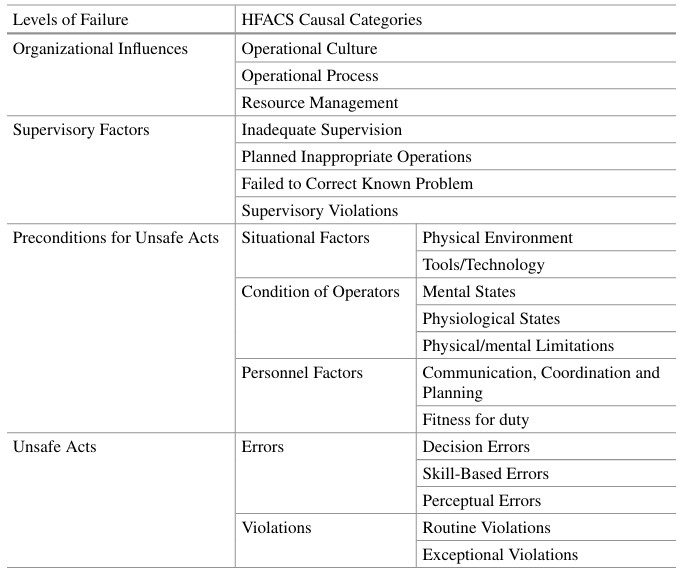
Human Factors Analysis and Classification System (HFACS) Framework
The engineer’s conscious choice not to implement the new ALS section qualifies as a decision error, possibly driven by misinterpretation of responsibilities — aligning with the Dirty Dozen factor of norms.
The preconditions for the unsafe act include all previously identified Dirty Dozen issues. In HFACS terms, these fall under personnel factors — specifically communication, coordination, and planning. The maintenance programs function of the engineering and maintenance organization interacts with several departments; the lack of proper coordination became a key failure point.
Moreover, the oversight mechanisms failed. Although a second engineer and a supervisor reviewed the ALS implementation, both missed the omission. This reflects inadequate supervision, another HFACS classification.
Finally, the organization’s operational processes lacked flexibility to identify or address unusual procedures like those involving the ALS.
Conclusion
This case demonstrates that compliance is not only about reacting to Airworthiness Directives, but about correctly interpreting and acting on all sources of continuing airworthiness information.
An unusual implementation pathway, combined with assumptions, unclear responsibilities, and insufficient cross-functional coordination, allowed a mandatory requirement to go unnoticed. The consequence was not only regulatory non-compliance, but grounded aircraft and operational disruption.
Ultimately, this was not a human failure, but a system failure.
Learn how to avoid compliance gaps in Aircraft Maintenance Programs →
Author
David Lapesa Barrera is the founder of The Lean Airline® and author of The Lean Airline: Flight Excellence and Aircraft Maintenance Programs. His work focuses on lean management, operational excellence, and continuing airworthiness.